Used Wheel Loaders for Africa: SDLG L955F vs LiuGong 856H vs CAT 950 — Hours, Price & Inspection (2027 Guide)
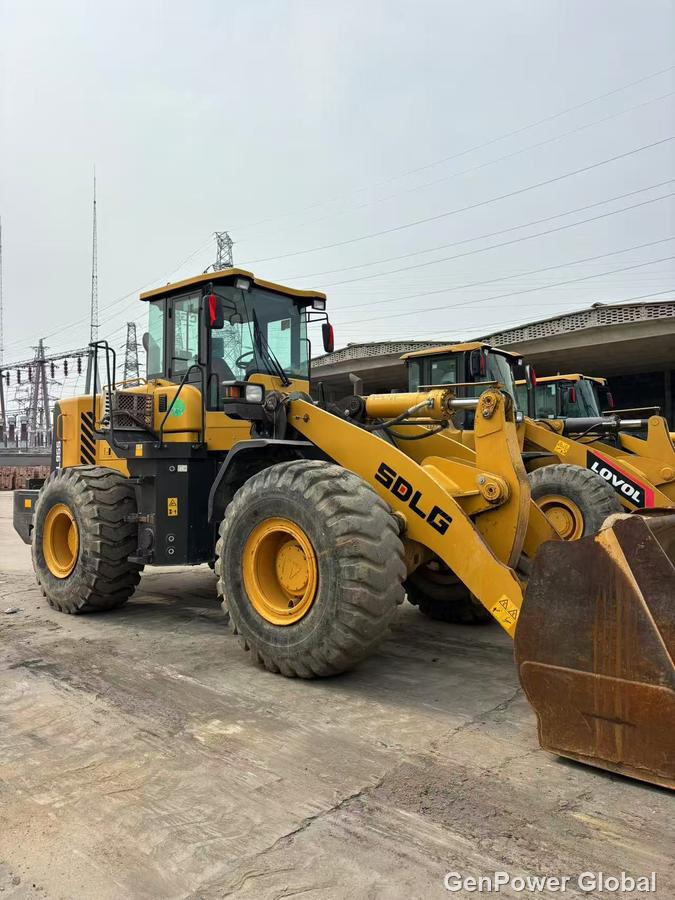
Last week we listed a June 2019 SDLG L955F in our Hebei yard at 103,000 RMB — about 14,500 US dollars FOB. The same morning a buyer asked me whether he should instead stretch for a used CAT 950, and another swore by his old LiuGong 856H. All three are 5-tonne-class machines that can earn their keep in Africa; what separates a good buy from an expensive one is not the badge but the hours you can verify, the four wear points you photograph before paying, and the price band you refuse to leave. This guide is that conversation written out.
1. The three machines, and what each one is for
The SDLG L955F and the LiuGong 856H are China’s two volume answers to the same job: a 5-tonne-rated loader for aggregates, sand, ports, brick plants and light mining. The L955F runs a Weichai WP10 common-rail engine at 162 kW with a plain, well-proven driveline; the 856H is LiuGong’s newer cab and transmission package built on the same 5-tonne layout. Both are machines any competent diesel mechanic in Lagos or Nairobi can keep alive, and both have genuine parts networks behind them.
The Caterpillar 950 family plays a different position. A used 950H or 950GC carries the strongest resale liquidity of the three, the deepest dealer support, and a price to match — typically two or three thousand hours older for the same money, or roughly double the outlay for a comparable-year unit. For a fleet that already runs CAT and bills CAT rates, that can still be rational. For a first-time buyer funding one machine out of working capital, it usually is not.
The honest framing is this: the CAT is the safest badge and the most expensive mistake if you buy a tired one; the Chinese-brand pair are the better value per verified hour, provided you do the inspection work this guide describes. If you are comparing excavators at the same time, our CAT 320D2 vs Komatsu PC200 comparison covers the same logic for diggers.
Match the machine to the business, not to the badge. A quarry or block plant running two shifts burns hours and rewards the cheapest reliable cost-per-hour, which is the Chinese-brand case. A rental fleet that hires out with operators earns day rates on uptime and name recognition, where a CAT badge on the quote sheet genuinely wins work. And a trader buying to resell after a season of work should price the resale spread honestly: the CAT gives back more at exit, the Chinese machine costs much less at entry, and both routes can clear the same margin if the purchase inspection is done properly.
2. What a used 5-tonne loader costs FOB China in 2027
The bands below are what we see quoted in the Chinese used market for honest-condition machines, stated as 2026/2027 references and always subject to a live quote. Hours, tyres and documentation move each unit within these bands.
| Class | Typical machines | Indicative FOB China (USD) |
|---|---|---|
| 3 t | SDLG 933/936, LiuGong 835, XCMG ZL30 | 6,000–12,000 |
| 5 t — Chinese brand | SDLG L955F/L956F, LiuGong 856H/N | 10,000–20,000 |
| 5 t — Western badge | CAT 950H/950GC, Komatsu WA320-380 | 22,000–40,000 |
| 6 t and up | CAT 966, Komatsu WA380-480, LiuGong 862 | 20,000–45,000 |
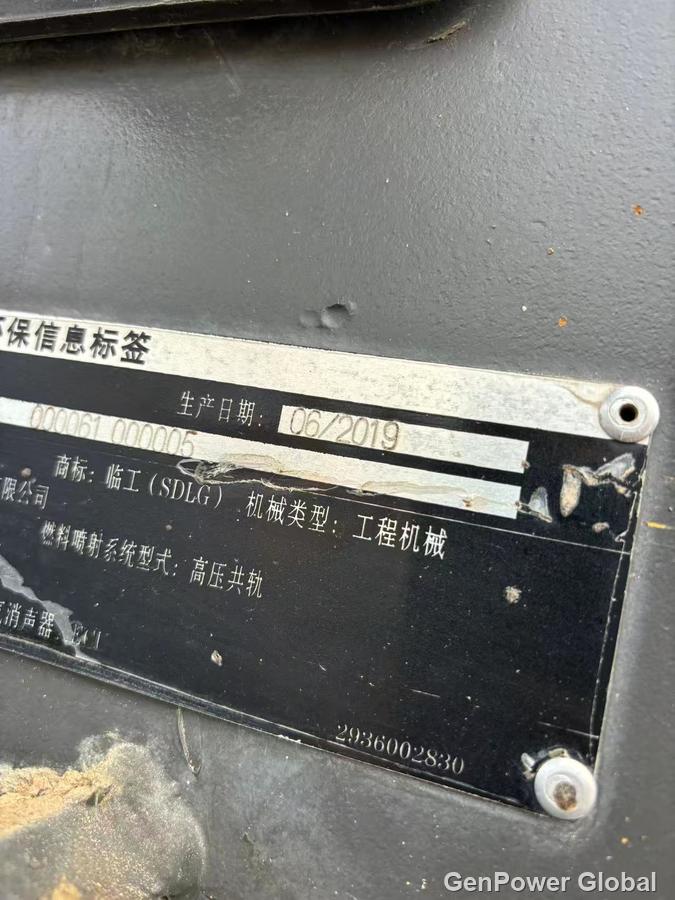
Our L955F anchor sits mid-band rather than at its floor, and that is deliberate pricing: the nameplate says June 2019, the frame stamp agrees with it, the meter sits at roughly 3,000 hours on the owner’s records, the bucket and tyres show honest workwear instead of a suspicious refresh, and every plate is photographed on the L955F detail page. A machine with unverifiable hours and no stamp photos should price below the band floor — or walk away from your money entirely.
Budget notes: tyres are the item first-time buyers forget. A 23.5-25 set is four to five figures depending on brand, so photograph the sidewalls and price the remaining tread into your offer. And decide bucket configuration before comparing quotes — teeth versus bolt-on edge versus a tired edge that needs rebuilding is a real spread at this class.
One practical note on negotiating: the photo file is your leverage. Sellers of honest machines volunteer label photos, stamp photos and bucket close-ups precisely because they have nothing to hide, and those photos justify a mid-band price. When a seller resists photographing the stamp or the articulation joint, that resistance is information, and the correct response is not a harder haggle but a cheaper one — price the unknown at the cost of the worst realistic outcome, then let the seller find a braver buyer.
3. Hours and year: reading them right on a loader
Wheel loaders earn their hours slowly — cycle work, short moves, less heat soak than an excavator — so hours on a loader understate wear faster than they do on a digger. A 5-tonne machine with 5,000 verified hours and a coherent story is routinely a better buy than a 2,000-hour unit whose meter nobody can explain. Read hours against four cross-checks: pedal and seat wear, tyre age and brand match across the four corners, cutting-edge thickness, and whether the hour-meter reading appears anywhere in service stickers or invoices.
Year matters most where it intersects with paperwork. On Chinese-brand loaders the emissions label carries the production date, and the frame carries a stamped serial whose digits encode the build period — on our L955F the stamp 4124Z-19062052 carries the same 1906 as the label’s 06/2019. When a seller’s claimed year and these two marks disagree, believe the marks. That is also why we photograph both and put them on the page: it converts “trust me” into evidence.
Then drive it, because a loader tells on itself in motion. Cycle it loaded if the yard allows: lift to full height, tilt out, lower, repeat ten times and watch for drift on the lift cylinders and any shudder near the end of stroke. Sweep the steering lock to lock on the move and feel for the hesitation that announces articulation wear. Hold the brake on a slope. Listen at the transmission for the whine that a filter change will not fix. Ten minutes of driving surfaces more truth than an hour of photographs, and it costs nothing but the seller’s patience.
4. Parts and service in Africa
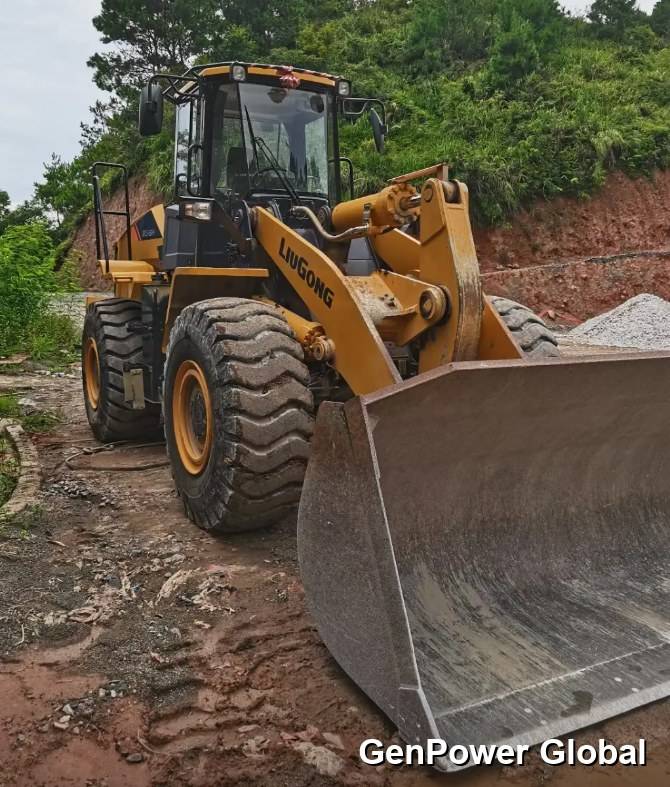
The L955F’s Weichai engine is the same WP10 family that powers thousands of Chinese trucks, excavators and generator sets already running across East and West Africa, which means filters, injectors and turbochargers move through the ordinary parts markets at commodity prices. The ZF-based transmission and axles on the F-series are equally well known to transmission shops from Johannesburg to Nairobi. The 856H enjoys the same depth through LiuGong’s own network, which in several markets is the single strongest Chinese-brand dealer footprint on the ground.
The CAT advantage is real but narrower than buyers assume: genuine-parts availability is unmatched for specialist items, yet a 950-family part on a used machine often arrives with a genuine-parts price on a non-genuine budget. Our standing advice is the same whatever the badge: ship a first-service kit with the machine — filters for engine, fuel and hydraulics, plus drive belts — and record exact part numbers before the container is sealed. For a fuller view of moving used equipment, the Africa importer’s guide covers all three machine families.
Service reality on the ground matters as much as parts supply. WP10 and the LiuGong equivalents run the same service intervals and largely the same consumables as the construction fleets local mechanics already maintain, so your operator and your fitter can service what they already know. Put the service schedule in the cab in the language your crew reads, stock the first 500 hours of filters before the machine leaves China, and insist the machine arrives with its manuals — the wiring diagram alone saves a week of tracing when a connector fails in the rainy season.
5. The four wear points that decide a loader deal
Loaders forgive neglect less visibly than excavators, so the inspection list is short and non-negotiable. These are the four points where money is won or lost, and the ones we photograph before any loader goes on this site.
1. The articulation joint. The hinge between front and rear frames is the machine’s spine. Rock the steering side to side with the engine off and watch for free play at the joint; check for fresh weld or misaligned shims around the pins. Significant articulation play is the single most expensive flaw a used loader can hide, and it cannot be fixed cheaply.
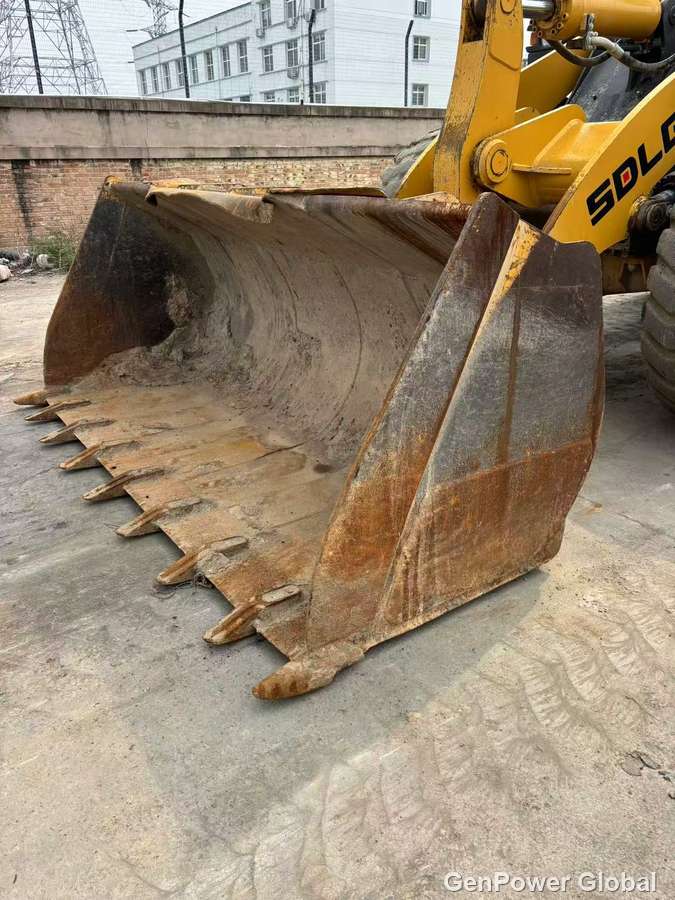
2. The bucket cutting edge and teeth. Teeth are consumables; the edge beneath them is not. Our L955F’s bucket is photographed exactly as found — honest wear on the teeth, readable metal on the edge. What disqualifies is a hairline-cracked edge or a corner that has been built back up with weld and never ground straight.
3. Tyres. Four 23.5-25 tyres can be worth several thousand dollars. Check tread depth across the full width, sidewall cuts down to cord, and whether all four are the same brand and age — a mixed set tells you the machine has eaten tyres, and the newest one tells you when.
4. Lift and tilt cylinders. Scored rods weeping oil, or a chrome rod that looks too new against an older machine, both mean money. A re-chromed or replaced rod is acceptable — if it is disclosed and priced. Fresh paint on one cylinder only is a disclosure, not a feature.
Run these four, then read the paperwork: label date against frame stamp, exactly as described in Section 3. A machine that passes the four points and the paperwork check is buyable at mid-band; one that fails any of them is buyable at a deep discount or not at all.
Close the loop with paperwork of your own. Before money moves, ask for the four wear points, the label, the stamp and the hour meter in a single photo set, dated; if the seller cannot produce it, your inspection trip or your agent’s is not a formality but the actual purchase test. We build that file for every unit we list because it is the same file we would want as buyers — and it is why the L955F page you can open today has its label and stamp one click away from the price.
6. Compliance and shipping
Nothing about the import process changes because the loader is Chinese or American. Wheel loaders clear under their own HS heading with duty and VAT by country; Kenya’s PVoC programme normally requires a Certificate of Conformity issued before shipment, and Nigeria clears through Form M and PAAR. Treat all of it as orientation and confirm with KEBS and SON, subject to the latest official notice — our Kenya & Tanzania import-rules guide walks the full process.
On the sea leg, a 5-tonne loader is a ro-ro or flat-rack conversation rather than a plain container: ro-ro out of Shanghai or Qingdao to Mombasa or Lagos has recently run in the low thousands of US dollars, while a 40ft flat-rack costs more but protects the machine better. Every figure here is a 2026/2027 reference, subject to a live quote and the latest official notice on surcharges.
Prepare the machine for the leg itself: disconnect the batteries, pad the boom and bucket contact points, drain nothing but document all fluid levels in the condition report, and photograph the loader strapped on its rack before the vessel sails. The photographs cost ten minutes and settle almost every damage dispute before it can start.
7. FAQ
Is the SDLG L955F a good wheel loader for Africa?
For aggregate, sand, port and light mining work, yes. The L955F pairs a Weichai WP10 common-rail engine with a plain, well-proven driveline, its parts follow the same supply channels as the Chinese truck and excavator fleets already in Africa, and used examples trade at roughly half the price of a same-class CAT. Inspect the articulation, bucket edge and tyres before you pay, and it is a sound workhorse.
SDLG L955F or LiuGong 856H: which should I buy?
They are direct 5-tonne-class rivals and both are safe choices. The 856H is the newer cab and transmission package with a slightly stronger dealer presence in some markets; the L955F usually prices lower used and shares the Weichai engine family that most local mechanics already know. Buy on unit condition and verified hours rather than on the badge.
How much does a used 5-tonne wheel loader cost FOB China?
In the Chinese used market through 2026, a Chinese-brand 5 t loader in honest condition typically quotes between 10,000 and 20,000 US dollars FOB, subject to a live quote. A used CAT 950-family machine of similar age normally starts well above that. As a concrete anchor, our June 2019 SDLG L955F is listed at 14,500 US dollars FOB with its label and frame stamp photographed.
How many hours are acceptable on a used wheel loader?
There is no single cut-off. A 5-tonne loader with 5,000 verified hours and a documented service history is often a better buy than a 2,000-hour unit with an unreadable meter. Treat hours as a cross-check, not a verdict: match the meter against pedal wear, tyre age, cutting-edge wear and the machine's overall honesty, and always ask for a controller photo.
What should I check before paying for a used wheel loader?
Four points decide most loader deals: the articulation joint (play here is the machine's single most expensive flaw), the bucket cutting edge and teeth, tyre sidewalls and remaining tread, and lift-cylinder rods for scoring or fresh welds. Then read the frame stamp and emissions label against each other, exactly as we show on our L955F detail page.
Do used wheel loaders need PVoC or SONCAP clearance?
Yes, wheel loaders are machinery imports like any other. Kenya normally requires a PVoC Certificate of Conformity issued before shipment, and Nigeria clears through Form M and PAAR with duties set by HS heading. The process does not change with the badge on the machine; confirm current requirements with KEBS and SON, subject to the latest official notice.
The short version
In the 5-tonne class, the smart African buy is the machine whose hours, stamp and wear you can verify at a mid-band price — and right now that machine is often a Chinese-brand loader like the L955F or 856H rather than a tired CAT at the same money. Our June 2019 L955F at 14,500 dollars FOB is exactly that kind of unit: label and stamp agreeing, bucket photographed as found, price mid-band with nothing to hide. Compare it with the rest of the loader stock, read our excavator comparison if diggers are next on your list, and if you want the full photo file and a CIF number, send us your port. General export questions are answered on our FAQ page.
Prices, dates and wear notes in this guide are 2026/2027 references checked against the machines in our yard; every figure is subject to a live quote and the latest official notice of the relevant authorities.