7,986.5 Hours on Camera: What an Hour-Meter Photo Changes When You Buy a Used Excavator (2027 Guide)
Every excavator listing in the used trade quotes hours. Almost none of them photograph the meter. The number arrives as a claim — “approx. 8,000 hours, per owner records” — and the buyer quietly pays for that softness in every offer they make. This week we listed something different: a 2020 Sumitomo SH260LC-6 whose monitor reads 7,986.5 hours, photographed on the machine in October 2026, with the reading visible in the same frame as the SUMITOMO dial and the dust it earned. It is the first unit in our yard listed this way, and it is a good excuse to write down what a meter photo actually changes — what it proves, what it does not, and how it should move the price.
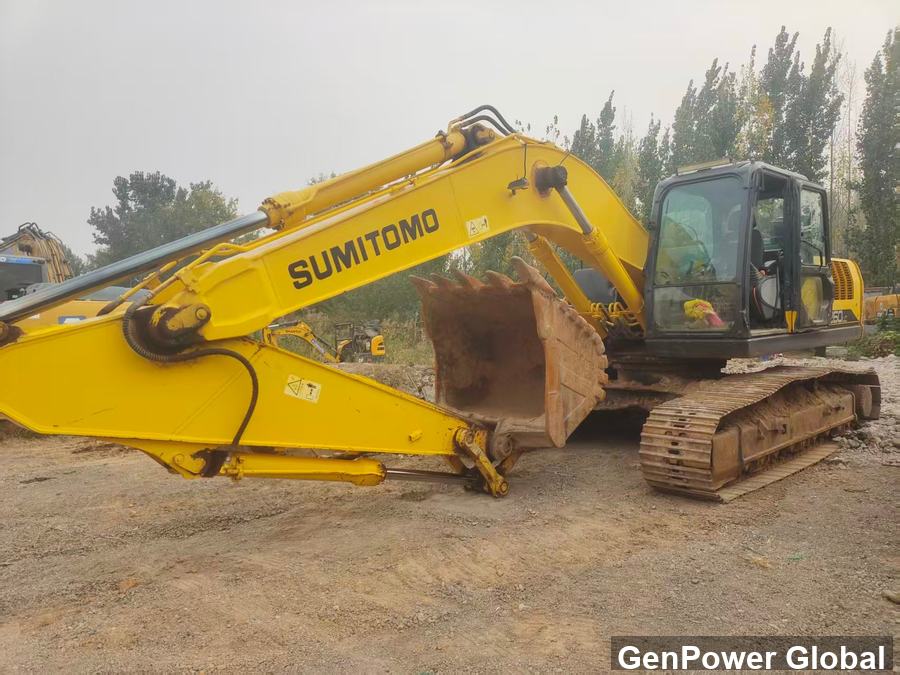
1. The unit, and the photograph
First the machine. The SH260LC-6 is Sumitomo’s 25-tonne tracked excavator — a class that African quarry and construction buyers often reach for when a 22-tonner feels undersized but 30 tonnes overshoots the budget and the transport plan. This unit’s environmental label carries a date sticker of 01/2020, its nameplate reads PIN STC260C6L00BH1677, and the engine is the Isuzu 4HK1-XDHAG-01-C3, a four-cylinder common-rail diesel whose family needs no introduction in the African parts trade. The owner’s records quote 25,500 kg operating weight and a 1.1–1.4 m³ bucket; both are marked as owner figures on the listing, the same way we mark them everywhere.
The class deserves a word of its own, because buyers stepping up from 22-tonne machines often misjudge what the extra three tonnes buy. A 25-tonner is not a 22-tonner with paint added: it swings a meaningfully larger bucket, loads the same trucks in fewer passes, and handles the dense material — weathered rock, compacted clay, iron-rich ore — that keeps a 22-tonner working at its ceiling all day. In production digging, that difference shows up as cycles per truck, and cycles per truck is money. It is also why the used market for this class moves quickly when a well-documented unit appears: buyers who run 20-tonne fleets add one 25-tonner for the heavy face of the work rather than replacing the fleet, and those buyers read listings the way accountants read invoices — line by line, evidence first.
Then the photograph. The monitor in the cab reads 7,986.5 hours — not “about 7,900”, not a round number worn smooth by retelling, but a half-hour-precise reading on the machine’s own SUMITOMO display, photographed on 16 October 2026 in Shijiazhuang, Hebei. The date stamp matters as much as the reading: a meter photo without a date is a claim in a nicer font. Together they turn the hour figure from the softest number in the file into the hardest one.
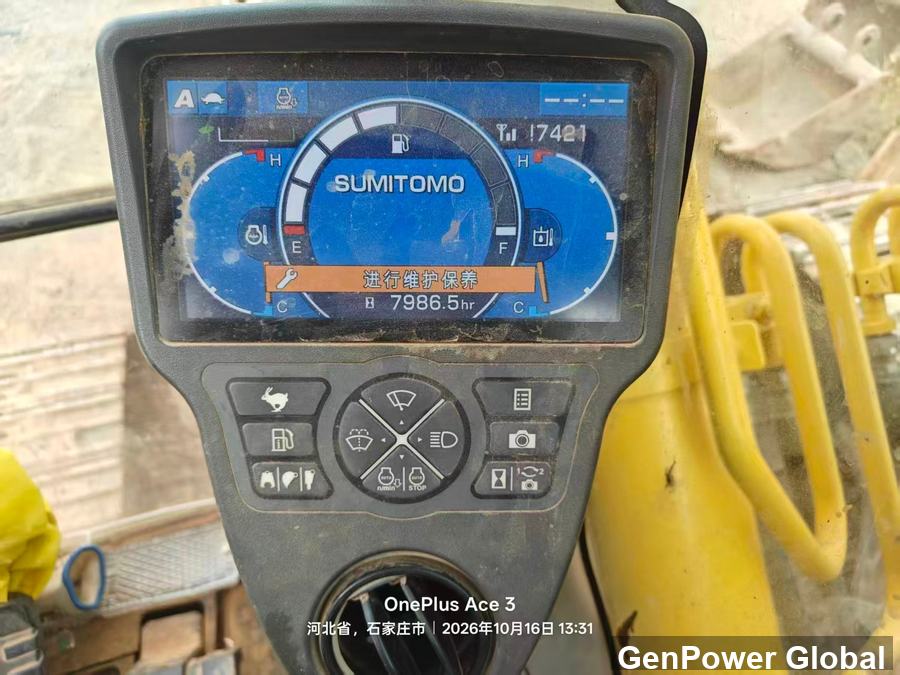
2. What a meter photo proves — and what it doesn’t
What it proves: that on a dated day, the machine’s installed display read 7,986.5 hours. That single fact does a lot of work. It removes the gap between “recorded” and “recorded somewhere”; it shows the meter is alive and specific rather than reset, swapped or frozen; and it gives you a fixed reference point for everything else in the file. If the seller later says the machine “just left the site after a long contract”, the photo anchors when and what was claimed.
There is also a negotiation arithmetic that buyers rarely spell out but everyone practises. When hours are a claim, the buyer discounts the asking price by the cost of the worst case — the machine might have 12,000 real hours — so a fair offer for an honest 8,000-hour machine is impossible to make: whatever number protects the buyer insults the seller. A meter photo shrinks the worst case to a narrow band, and suddenly offers can be precise: wear items priced from photographs, the meter taken as read, and the negotiation spent where it belongs — on the machine’s actual condition, not on stories about it. Sellers benefit too: the documented unit sells faster and closer to asking because the buyer’s uncertainty discount has nowhere to hide. That two-sided effect is the quiet reason we now photograph the meter on every unit in the yard, and it is why the practice will spread through this trade faster than any standard could.
What it does not prove: that the hours were accumulated gently, or even by this machine’s current engine. A meter records ignition hours, not mercy. Wear verification remains a separate discipline — undercarriage percentage, pins and bushings, hoses, pump efficiency, swing backlash — the checklist we laid out in the high-hour buyer’s guide and photographed as found on this unit’s detail page. And a meter can be rolled back on some machines; the defence is not paranoia but cross-checking, which is the next section.
The honest summary is asymmetry: a meter photo cannot prove a good machine, but a missing one leaves you buying the biggest number in the deal on faith. That is why we have started photographing the meter on every unit that comes through the yard, and why the SH260LC-6 listing leads with it.
3. Reading the file: meter, labels, story
A meter photo earns its keep in cross-checks. Run this unit’s file as an example. The meter says 7,986.5; the owner’s pre-listing records said “about 7,900” — consistent within rounding, exactly what you want when a claim and a photo meet. The label’s date sticker says 01/2020; six years of steady work to October 2026 multiplies out to roughly 1,600 hours a year, a normal commercial rhythm, not the 3,000-hour double-shift profile that should show far heavier wear than this machine’s photographs do. The seat, the pedals and the cab photographs show honest use without the shine-through-to-foam that a true 20,000-hour machine displays.
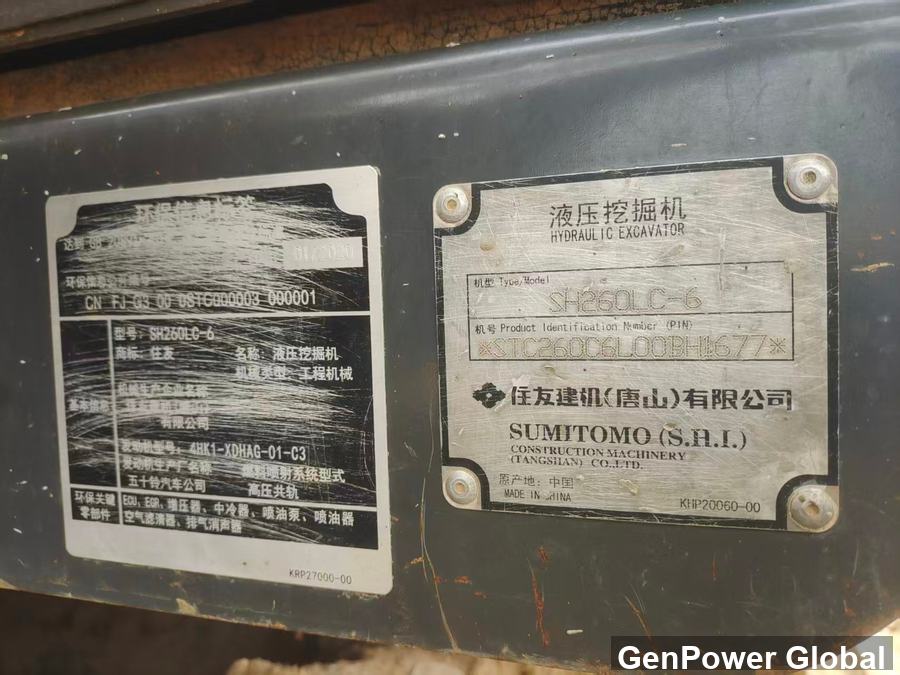
When meter, label, wear and story all multiply out to the same answer, the file hangs together — and price can be discussed on the machine rather than on trust. When they disagree, you have saved a deposit for the price of a message asking for one photo. That is the entire discipline of remote used-equipment buying, and it is why our standard first reply to any enquiry is a set of photographs rather than a price concession.
4. Tangshan-built Sumitomo: the China-built story, again
Sharp-eyed readers of our China-built Kobelco guide will recognise the pattern on the nameplate: the badge says SUMITOMO, the stamping says Sumitomo Construction Machinery (Tangshan) Co., Ltd., MADE IN CHINA sits in the lower corner, and the environmental label names Isuzu Motors as the engine producer. The logic is the same as the Kobelco’s. Sumitomo, like every major brand, builds a large share of the machines sold into China’s domestic market inside its own Chinese plants, to its own specifications, certified against China’s national standards — this one carries GB20891-2014 Stage III on its label.
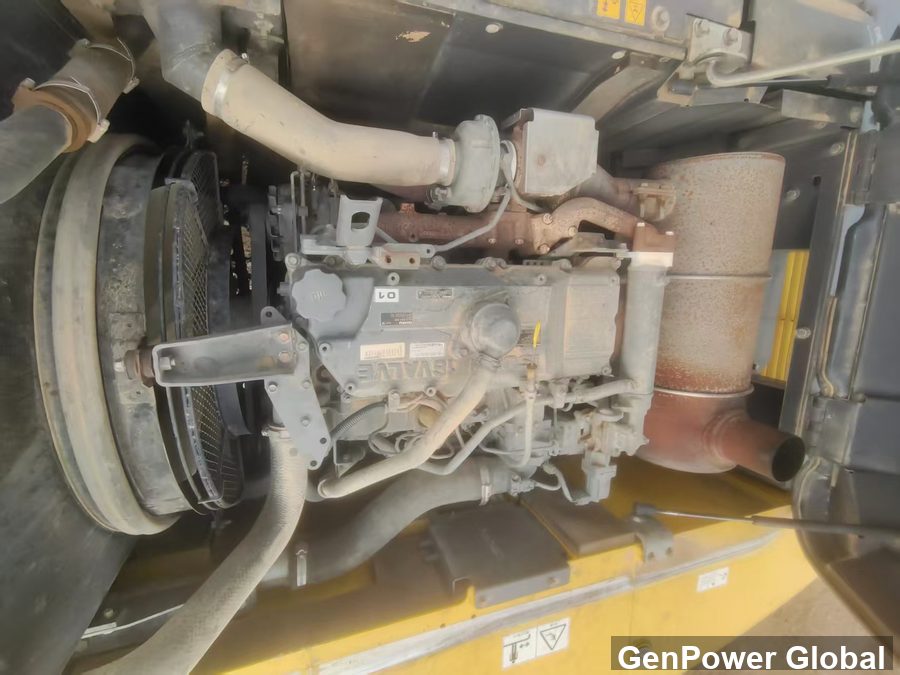
What the assembly location changes for an export buyer is refreshingly little. The 4HK1 engine family is everywhere in the African parts trade; the machine number on the invoice matches the stamping on the frame; and at resale, the next buyer asks about the badge, the engine and the hours — three lines on which this unit is strong. What the labels change is your knowledge: you know exactly which factory built the machine, which engine powers it, and which standard it was certified to. In a trade where too many listings hide behind a badge, two photographed labels are worth more than any adjective we could write.
5. Price: where a 25-tonner with a camera-verified meter sits
Here is the table we can stand behind — four documented machines in our yard, photographed plate to undercarriage, priced on their own evidence.
| Machine | Class | Year / hours | Indicative FOB China (USD) |
|---|---|---|---|
| SANY SY215C | 22 t | 2019, 6,568 hrs | 29,200 |
| Sumitomo SH260LC-6 | 25.5 t | 2020, 7,986.5 hrs (on meter) | 47,900 |
| Sumitomo SH360 | 30 t | 2019, approx. 12,000 hrs | 39,400 |
| Kobelco SK350LC-10 | 35.5 t | 2018, approx. 9,000 hrs | 53,500 |
One row needs explaining, because honest pricing sometimes looks upside down. The SH260LC-6 prices above the 30-tonne SH360 despite carrying less iron. The reasons are the three numbers to its right: it is a year newer, it has barely half the hours, and those hours are on camera rather than on record. The used market prices evidence and youth together, and a 2020 machine with a four-digit meter is, for most buyers, the less risky cheque even at less tonnage. For buyers whose work genuinely needs 30 tonnes of mass, the SH360 remains its own case — that trade-off is the subject of the high-hour guide.
Shipping notes belong in the same paragraph as price: at 25.5 tonnes this machine moves on a flat rack or break-bulk rather than in a container, freight is quoted per sailing, and over-height cargo space swings with the season — book the flat rack before the deposit. Every figure in the table is indicative and subject to a live quote; ask us for a CIF number tied to a real sailing.
A note on how to use the meter photo in your own offer, since it is the newest tool on the table. Anchor your number to the reading — “at 7,986.5 hours on camera, I’m at X” — and attach your wear pricing to the photographs rather than to fear: if the undercarriage reads 40 percent worn in the pictures, say what 60 percent of life is worth to you and offer accordingly. Offers built this way get answers in hours rather than weeks, because the seller can see the offer was built on the same file they published. And if any element of the file does not survive your cross-checks, name it in the message; a seller standing behind their documentation will re-photograph, re-film or re-price without argument, which is itself the last verification step in the whole process.
6. The updated remote-verification checklist
With the meter photo added, the file we now assemble on every listing runs to five photographs and one video. Photograph one: the environmental information label — engine producer, machine producer, engine model, date, machine number. Photograph two: the stamped nameplate — brand, model, PIN, origin marking. Photograph three: a wide shot proving the labels and the machine are one unit. Photograph four: the hour meter, dated. Photograph five: the hour-relevant wear — seat and pedals, undercarriage, track links. The video: cold start, swing both ways, one full dig cycle, undercarriage walked end to end. That is the whole discipline. Buyers who want the deeper why behind each item will find it in the hours-versus-year guide and the Kobelco piece; buyers who just want the file can simply ask — it is assembled before any deposit moves.
One upgrade completes the file: the video. A photograph proves the meter at a moment; a video proves it over minutes, with the machine running, swinging and digging while the reading sits in frame — and with the cold-start behaviour, exhaust and cycle times that no still image carries. We record this footage before shipment on request, dated like the photographs, and serious buyers should make it a standing condition of any offer rather than a special favour to negotiate for. Between the photo file and the video, the distance between your desk and our yard shrinks to the length of a message thread — which is the entire point of documenting machines properly in the first place.
7. Red flags: the meter-specific list
Meter evidence attracts its own tricks, so run this list on any hours-driven listing, ours included. 1. A round, worn number. 8,000 even, quoted the same way by everyone who ever sold the machine, with no photo — the number has been marketing for years. 2. A meter photo without a date. Undated evidence is a claim in a nicer font; insist on the date in frame or in the message header. 3. A display that does not match the machine. The monitor brand should match the badge; a generic gauge cluster where a SUMITOMO dial should be means the display — or the machine — has a story. 4. A reading that fights the wear. 7,986 hours on a machine whose seat is torn through and links are razor-thin is either a hard six years or a soft meter; both need explaining. 5. One photo, no set. A meter photo among twelve honest photographs is evidence; a meter photo as the only photograph is a costume. 6. “Meter just replaced” without paperwork. A new meter is a real event with an invoice and an old reading; without either, it is a haircut for the number.
Why does a meter photo matter so much on a used excavator?
Because the hour reading is the single number every other part of the deal hangs on: the price, the wear expectations, the resale story. Most used listings quote hours as a claim - 'approx. 8,000 hours per owner records' - which forces you to price the seller's honesty instead of the machine. A dated meter photo upgrades the reading from a claim to an exhibit: our 2020 Sumitomo SH260LC-6 shows 7,986.5 hours on its monitor, photographed in October 2026, so the number you negotiate against is the number in the picture. You still verify wear - a photo proves the reading, not the machine - but the first and biggest uncertainty is gone.
Can a meter photo be faked?
Cheaply faked photos can be; genuine ones are hard to fake in a set. The tells are consistency: a real meter photo shows the machine's own brand on the display (ours reads SUMITOMO), plausible gauge values around the dial, dust and wear consistent with the rest of the photos, and - the strongest cross-check - a reading that agrees with pedal wear, seat condition, undercarriage percentage and service stickers across a dozen other photographs. That is why one photo beats a claim, but a photo set beats one photo. For shipments we can also record a dated start-up video with the meter live in frame, which is the strongest version of this evidence.
What does 7,986.5 hours mean on a 2020 machine?
It averages roughly 1,600 hours a year since the label date of 01/2020 - steady commercial work rather than abuse or idleness, and comfortably below the wear points where big-ticket components dominate the negotiation on a 25-tonne Japanese machine. The half-hour precision is itself information: meters that read in halves are live meters doing their job, and a reading this specific is a good sign the display has never been reset or swapped. As always, the number opens the conversation and the wear photos finish it - our SH260LC-6 page carries the undercarriage, track links and swing bearing photographed as found.
What does a used 25-tonne excavator cost FOB China?
Documented anchors from our own yard: the 2020 Sumitomo SH260LC-6 at 7,986.5 hours on camera lists at 47,900 US dollars FOB; the 2019 Sumitomo SH360, 30-tonne class at about 12,000 hours, lists at 39,400; the 2018 Kobelco SK350LC-10, 35.5 tonnes at roughly 9,000 hours, lists at 53,500; and the 2019 SANY SY215C, 22 tonnes with 6,568 hours and service records, lists at 29,200. Price tracks year, hours and tonnage together, and every figure is indicative and subject to a live quote.
Is a China-built Sumitomo the same as a Japan-built one?
It is a factory-built Sumitomo, assembled by the brand's own Chinese entity - our unit's nameplate reads Sumitomo Construction Machinery (Tangshan) Co., Ltd. with MADE IN CHINA stamped under it, and the environmental label names Isuzu as the engine producer. The badge, the engineering lineage and the parts story run through Sumitomo; the assembly happened inside China, like the majority of machines sold into the world's largest excavator market. We covered what this means for parts, emissions paperwork and resale in our China-built Kobelco guide, and the same logic applies here: read the labels, not the assumption.
What should I ask for besides the meter photo before paying?
Four photographs and one video, the same file we assemble on every unit: the environmental label, the stamped nameplate, a wide shot proving the labels belong to this machine, and the meter - then a dated video of cold start, swing, dig and the undercarriage walked end to end. Add a written wear percentage for the undercarriage if you are pricing it into the offer. None of this is exotic; any honest seller produces it within a day. A seller who resists the meter photo specifically has answered your question about the reading in the cheapest possible way.
The short version
A meter photo converts the most contested number in a used-excavator deal from a claim into an exhibit. Our 2020 SH260LC-6 carries 7,986.5 hours on camera, dated October 2026, with both labels, the 4HK1 engine bay and the undercarriage photographed on the detail page — and a dated start-up video available before any deposit moves. Compare it with the rest of the excavator stock, read the high-hour guide for the wear checklist, and for the full photo file and a CIF number, send us your port. General export questions are answered on our FAQ page.
Prices, dates and readings in this guide are 2026/2027 references checked against the machines in our yard; every figure is subject to a live quote and the latest official notice of the relevant authorities.