Japanese Badges, Made in China: What a China-Built Kobelco SK350 Means for Export Buyers (2027 Guide)
A buyer wrote to us last week about the newest unit in our Hebei yard: a 2018 Kobelco SK350LC-10, 35-tonne class, listed at 53,500 US dollars FOB. His question was not about hours or price. It was one line: “The plate says MADE IN CHINA under a KOBELCO badge — is this a real Kobelco?” It is a fair question, and it is the question behind hundreds of listings across the used export trade, where badges say one country and plates sometimes say another. This guide answers it with the machine itself: we will read the actual labels with you, field by field, and then look at what China-built Japanese machines are, what they are not, and how to buy one without paying for a story.
1. The machine that raised the question
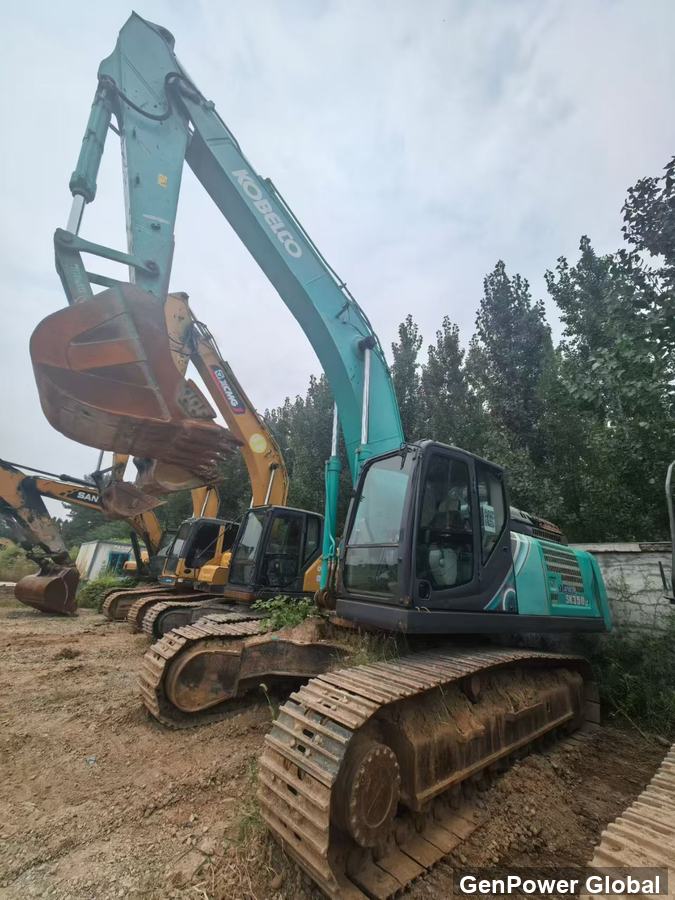
First, the machine on its own merits, because the badge debate should not distract from the hardware. This is a 35-tonne hydraulic excavator — operating mass 35,500 kg read straight off the nameplate — powered by a Hino J08E-TM six-cylinder common-rail diesel, with net power of 197 kW at 2,100 rpm also stated on the label. The bucket is 1.6 m³ per the owner’s records. The environmental information label gives a production date of 07/2018 and machine number YC14C10681, and the meter shows roughly 9,000 hours on the owner’s records. In a yard where our other documented diggers run from a 22-tonne SANY to a 30-tonne Sumitomo, this is the largest machine we have photographed to date, and it earns its keep in exactly the work African quarries and loading yards buy 30-tonne iron for: production digging, truck loading, and the heavy lifts that make a 20-tonner work twice as hard.
The hours arithmetic reads like steady work rather than abuse. Nine thousand hours since mid-2018 is roughly 1,500 a year — a machine that worked full seasons but was not double-shifted. For buyers who followed last week’s high-hour guide, this unit sits at the more comfortable end of the spectrum: high enough that the price is honest, low enough that the wear conversation is about maintenance history rather than reconstruction budgets. But this article is not a listing pitch; the reason this machine is interesting to write about is what its paperwork teaches. Almost every buyer who handles a China-built Japanese machine for the first time meets the same two labels and the same confusion. So let us read them.
2. What the labels actually say — read them with us
Chinese-market machines carry an official environmental information label (the environmental information label), and it is the single most informative sticker on the machine. Ours reads, line by line: trademark KOBELCO; model SK350LC-10; machine type, construction machinery; and then the two lines that answer the badge question. The engine production factory name is Hino Motor Co., Ltd. — Hino. The machine production enterprise name is Kobelco Construction Machinery (China) Co., Ltd. The engine model line reads J08E-TM with the fuel system marked high-pressure common rail, high-pressure common rail. The header states the production date, 07/2018, and the machine number, YC14C10681, and confirms the machine meets GB20891-2014, the third-stage national emissions standard.
Beneath it sits the stamped nameplate, and it agrees: KOBELCO brand, machine model SK350LC-10, operating mass 35,500 kg, net power 197/2100 (kW at 2,100 rpm), production year 2018, machine number YC14C10681 again — and in the lower right, the legal entity Kobelco Construction Machinery Co., Ltd. with its Hiroshima, Japan address, alongside the marking MADE IN CHINA. Read together, the two labels say something precise rather than mysterious: the engineering, the brand and the corporate line run back to Kobelco in Japan, while this particular machine was assembled in China by Kobelco’s own Chinese entity, around an engine supplied by Hino. Nothing is hidden and nothing is contradictory — the confusion only exists for buyers who were never shown the labels.
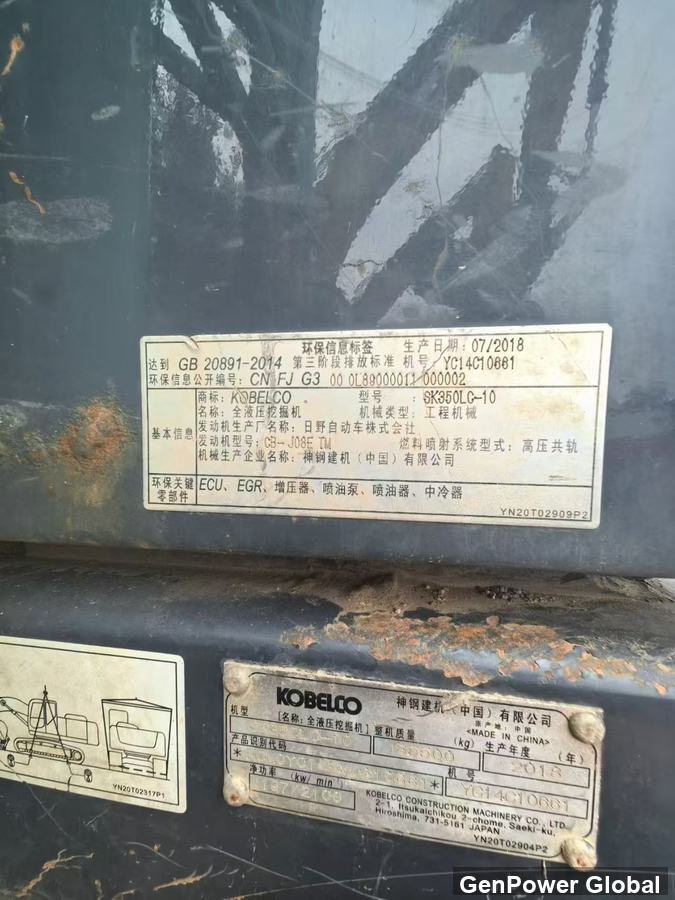
This label-reading habit costs nothing and pays everywhere. The same environmental label format appears on Chinese-market Komatsu, Hitachi, CAT and Volvo machines, and it always separates the two factory roles the same way. When you inspect any machine — ours or anyone’s — photograph that sticker first, before the shiny three-quarter beauty shots. A seller who volunteers the environmental label photo in the first message is telling you how the whole deal will go.
3. China-built Japanese iron: what it is and what it isn’t
What it is: mainstream. Most of the machines sold new inside China’s enormous domestic market — across every major brand — are assembled in that brand’s Chinese plants, by the brand’s own operating companies, to the brand’s own specifications, certified against China’s national standards. That is why the label names Kobelco Construction Machinery (China) Co., Ltd. as the machine producer: it is not a licensee and not a lookalike brand; it is the company’s own manufacturing footprint serving the world’s largest excavator market. A China-built SK350LC-10 is the same model family sold with the same badge because it is the same product line — produced where the domestic market buys it.
What it is not: identical, in every respect, to a same-model unit assembled in Japan for a different market — and pretending otherwise would be the other kind of dishonesty. Specifications, suppliers and emissions certifications are set per market. The China-market unit carries GB20891-2014 third-stage certification; a Japan-domestic or export-market unit carries its own. Cabin trim, gauge language, service intervals as documented, and the exact configuration of options can differ. None of this is a quality verdict — it is the ordinary way global manufacturers build for the market in front of them. The buyer’s job is not to ask “is it really Japanese?” but “which specification am I buying, and does my market accept it?”
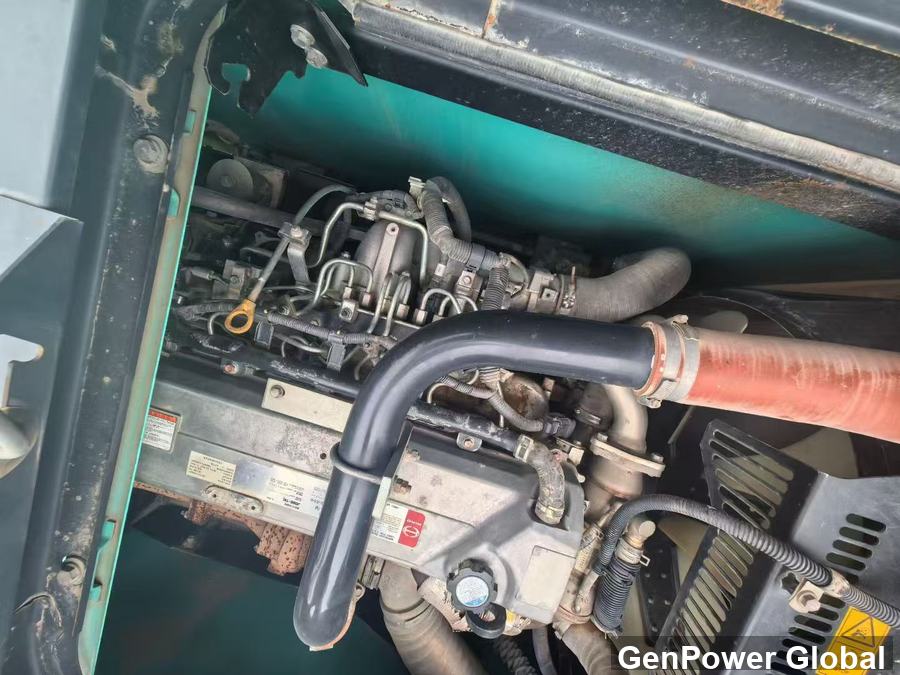
Where does the engine sit in this? Conveniently for the used trade, the engine is the part with the deepest cross-border continuity. The J08E-TM in our unit comes from Hino — an engine family with a long service history well known to fitters across East, West and Southern Africa. On the used market, an engine that parts counters everywhere already stock quietly de-risks the whole purchase, whichever country bolted it into the chassis. That is why, when we evaluate any China-built Japanese machine, we treat the engine label as the headline item — which is also exactly why we photograph it every time.
4. Does it matter for Africa-bound buyers?
Three practical questions decide this, and only one of them is about the badge. First, parts: covered above — the Hino engine is the easy part, and for machine-specific items your parts supplier only needs the machine number, which the label and the nameplate both carry. Second, emissions at destination: this is the question we answer most conservatively, because it is not ours to answer definitively. The machine is certified to China’s GB20891-2014 third stage, a factory sticker photographed on the body. What your destination country requires for an imported used machine — and whether its rules have changed this year — is decided by that country’s authority and your clearing agent, subject to the latest official notice. Kenya-bound shipments normally clear through a PVoC pre-shipment process, Nigeria through its own import documentation; send the label photos to your agent before you commit, and treat any online answer, including ours, as something to verify.
Third, resale in your market: this is where the badge question quietly turns from liability to asset. In most African used-equipment markets, buyers trade on brand familiarity and engine familiarity rather than on assembly geography — a Kobelco with a Hino engine reads as recognizable value at resale precisely because the badge and the engine are the parts the next buyer will ask about. The assembly plant does not appear in the resale conversation; the machine’s condition, its hours and its paperwork do. Which is why every unit we list carries its labels photographed rather than described: at resale, four years from now, the file you bought with the machine is the file you will sell with it.
5. How to verify a China-built Japanese machine remotely
The verification is the same whether you buy from us or anyone else, and it fits in four photographs and one video. Photograph one: the environmental information label, close enough to read the engine producer, the machine producer, the engine model, the production date and the machine number. Photograph two: the stamped nameplate, where the serial number is punched into metal — stampings are harder to fake than stickers, and wear patterns tell stories. Photograph three: a wide shot proving both labels live on the same machine — the confusion a cropped label photo can create disappears the moment the frame includes the boom and the yard. Photograph four: the hour meter, ideally in the same session. Then the video: cold start, swing through its arc, dig a cycle, undercarriage walked end to end. Ninety seconds of footage, as last week’s guide argued, answers more than an afternoon of messaging.
One cross-check that catches most fiction: the machine number should appear the same on the environmental label, the nameplate and the commercial invoice, and the serial prefix tells the assembly story to anyone who asks the brand’s distributor. On our unit the number YC14C10681 appears on both labels and will appear on the invoice we issue; the stamped plate is aged and photographed as found, and we tell buyers to re-verify the stamping on arrival — a worn stamp on an honest machine is normal, but verification is free. A seller who resists any of the four photographs, or whose serial numbers do not agree across documents, has answered your question in the cheapest possible way.
6. Price and value in the 35-tonne class
Rather than quote market averages we cannot stand behind, here is the table we can: three documented machines in our yard, photographed plate to undercarriage, priced on their own evidence.
| Machine | Class | Year / hours | Indicative FOB China (USD) |
|---|---|---|---|
| SANY SY215C | 22 t | 2019, 6,568 hrs | 29,200 |
| Sumitomo SH360 | 30 t | 2019, approx. 12,000 hrs | 39,400 |
| Kobelco SK350LC-10 | 35.5 t | 2018, approx. 9,000 hrs | 53,500 |
Read across the rows and the market’s logic shows itself: price tracks tonnage and hours together. The SK350LC-10 carries the largest mass and the mid-range meter, and it prices between the other two accordingly — roughly 35 percent above the 30-tonne Sumitomo, for 18 percent more machine and 3,000 fewer hours. Whether that trade suits your jobsite depends on the work: in production digging and heavy loading, the extra tonnage shows up as fewer passes per truck and less strain per cycle, which is the productivity argument laid out in the 30-tonne guide. Buyers scaling up from the 22-tonne class should also read our 20-tonne parts-cost comparison for the consumables picture before deciding where their fleet lands.
A shipping note that belongs with any 35-tonne purchase: this machine does not fold into a container. It moves on a flat rack or break-bulk, freight quoted per shipment, and vessel space for over-height cargo swings with the season — so book the flat rack before the deposit, confirm your port can discharge the unit, and expect the freight line to be a material fraction of the machine’s price. Every figure in this section is indicative and subject to a live quote; ask us for a CIF number tied to a real sailing rather than a percentage applied to the FOB figure.
7. Red flags when shopping this segment
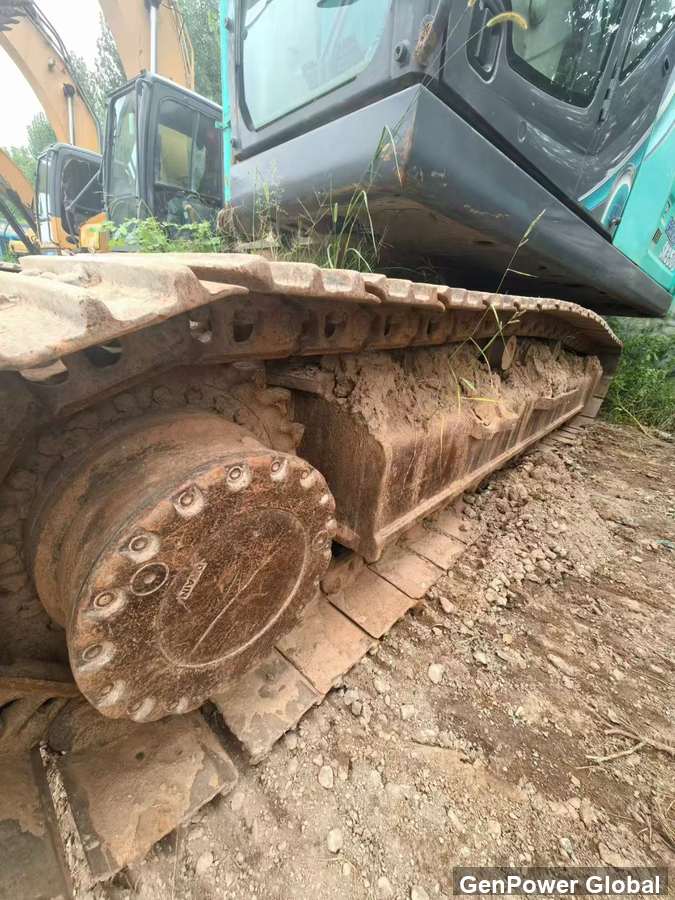
The China-built Japanese segment attracts its own particular dressing-up, so run this list on any listing in it, ours included. 1. Badge inflated, label withheld. If a listing shouts the Japanese brand but never photographs the environmental label or the nameplate, you are being asked to buy the badge alone — the two labels are produced in seconds by anyone standing next to the machine. 2. Serial numbers that disagree. Label, stamping and invoice must carry one machine number; disagreement anywhere in the chain is a walk-away signal. 3. Origin stories instead of labels. “Imported from Japan last year” is a claim; an environmental label naming a Chinese production entity is a fact — when both appear in one listing, ask which machine the story belongs to. 4. Emissions promises in writing. No exporter can guarantee what a destination authority will accept next month; anyone who does is selling certainty they do not own — the honest phrasing is the label photo plus “confirm with your clearing agent, subject to the latest official notice.” 5. Fresh paint on the undercarriage. Same rule as every class: nobody sprays rollers for fun. 6. No video. A 35-tonne machine at this money justifies a 90-second cold-start video in every message thread; its absence is a data point about the seller, not the machine.
Is a China-built Kobelco a real Kobelco?
It is a factory-built Kobelco, not a copy. The machine in our yard carries an official environmental information label naming two different entities: the engine was produced by Hino (the label reads Hino J08E-TM), while the machine itself was produced by Kobelco Construction Machinery (China) Co., Ltd., and the nameplate is stamped MADE IN CHINA under the KOBELCO brand. That is how the global industry actually works - most branded machine makers assemble a large share of their range inside China for the domestic market. What the badge tells you is the engineering lineage; what the label tells you is who assembled this particular machine. Read both and you know exactly what you are buying.
What is the GB20891-2014 Stage III label?
It is the emissions certification label required on non-road machinery sold new in China under the national standard GB20891-2014, third stage. On our SK350LC-10 the label sits beside the nameplate and states the production date (07/2018), the machine number and the certified engine. For export buyers its value is documentary: it is a factory-issued, photographable record that ties engine, machine number and production date together on one sticker. What emissions standard your destination market requires for an imported used machine is a separate question, decided by that country's authority - put the label photo in front of your clearing agent, subject to the latest official notice.
Are parts harder to source for a China-built Japanese excavator?
The engine is usually the easy part: the Hino J08E family in this unit is one of the most familiar six-cylinder diesels in the trade, and filters, injectors and turbo parts move through the same channels whether the machine was assembled in Japan or in China. For Kobelco-specific items, ask any supplier which factory built the machine - serial numbers beginning YC tell the story on our unit - and confirm part numbers against the machine number rather than the badge. We are not a parts distributor and we do not promise part availability in your market; what we do is photograph every plate so your parts man knows exactly which machine he is quoting.
How many hours is too many on a 35-tonne machine?
A 35-tonne class machine is built for production work, and well-maintained units commonly pass 20,000 hours, so the question is never the number alone. Our SK350LC-10 shows roughly 9,000 hours on the owner's records - about 1,500 a year since 2018, which is steady but not punishing. Judge a 35-tonner the same way as any machine: does the wear agree with the meter? Ask for the undercarriage wear percentage in writing, a dated start-up and dig video with the meter in frame, and photographs of the pins, hoses and swing gear before you discuss price.
What does a used 35-tonne excavator cost FOB China?
Documented anchors from our own yard: the 2018 Kobelco SK350LC-10, 35,500 kg per nameplate at roughly 9,000 hours, lists at 53,500 US dollars FOB; the 2019 Sumitomo SH360, 30-tonne class at about 12,000 hours, lists at 39,400; and the 2019 SANY SY215C, 22-tonne with 6,568 hours and service records, lists at 29,200. Price tracks tonnage, hours and paperwork together, and every figure is indicative and subject to a live quote.
How do I confirm which factory built a machine before I pay?
Three photographs settle it: the environmental information label (which names the engine producer and the machine producer separately), the stamped nameplate (which carries the brand, the serial number and often an origin marking), and a wide shot proving both labels belong to the same machine - the yard background and the serial number matching the invoice close that loop. Any seller can produce these in a day; a seller who explains that the two labels name different factories is showing you competence, not weakness.
The short version
A China-built Kobelco is a factory Kobelco — the labels say so plainly, once you know how to read them: brand and engineering from Kobelco, engine from Hino, assembly by the brand’s own Chinese entity, certified to China’s third-stage standard. Our 2018 SK350LC-10 carries roughly 9,000 hours on owner records at 53,500 dollars FOB, with both labels, the engine bay and the undercarriage photographed on the detail page; the meter photo and dated video complete the file before any deposit moves. Compare it with the rest of the excavator stock, read the high-hour buyer’s guide for the wear checklist, and for the full photo file and a CIF number, send us your port. General export questions are answered on our FAQ page.
Prices, dates and label readings in this guide are 2026/2027 references checked against the machine in our yard; every figure is subject to a live quote and the latest official notice of the relevant authorities.