Is a 12,000-Hour Used Excavator Worth Buying? Judging High-Hour Machines (2027 Guide)
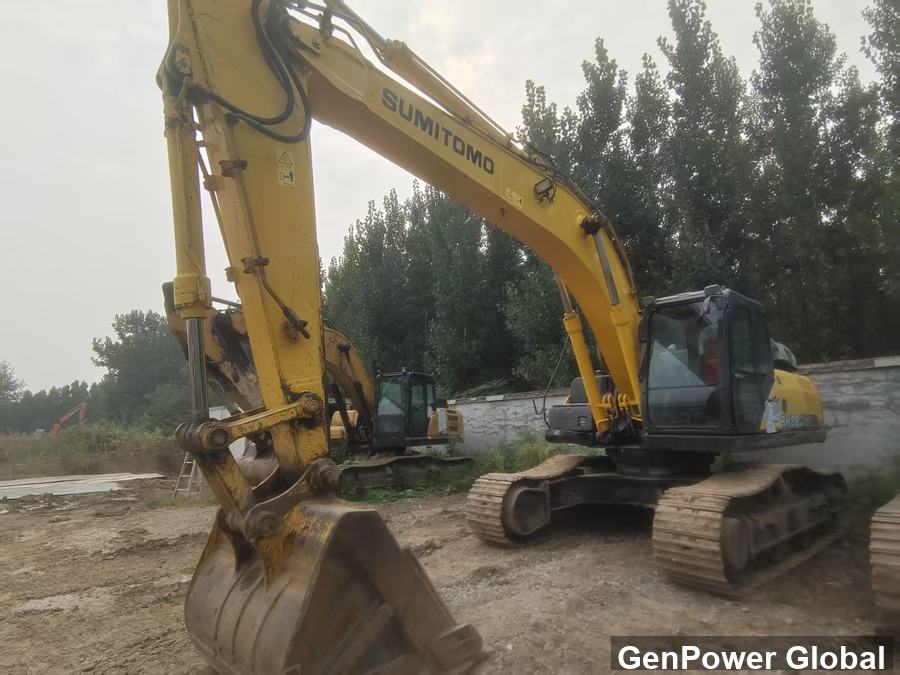
This week we listed a 2019 Sumitomo SH360 in our Hebei yard showing roughly 12,000 hours on the owner’s records, priced at 39,400 US dollars FOB. A seven-year-old 30-tonne machine with a five-digit meter divides every inbox it lands in: one buyer calls 12,000 hours a bargain for Japanese iron at this money, the next calls it a worn-out machine with a nice badge. Both are half right. This guide is how we judge high-hour machines — what the number actually tells you, where the wear shows first, and which single photograph settles more arguments than any hour count.
1. What 12,000 hours actually means on a 30-tonne machine
Start with the arithmetic instead of the reflex. A 2019 machine at roughly 12,000 hours by 2026 has averaged about 1,700 hours a year — that is steady commercial work: quarry shifts, loading trucks, production digging. It is not the profile of a weekend machine, and it is not the profile of abuse either; a two-shift site unit burns closer to 3,000 a year. The number tells you the machine worked for a living, which is exactly what you want in a used production digger — provided the maintenance worked for a living too.
The second thing the arithmetic tells you is what you are buying economically. Hours are depreciation you can see: the same model with 4,000 hours will cost meaningfully more than one with 12,000, and the question is only whether the price gap is wider than the wear gap. On the 30-tonne Japanese class the answer is often yes, because these machines were engineered around long-block service lives measured in tens of thousands of hours, and the Isuzu 6HK1 in this unit is one of the most familiar six-cylinder diesels in the African parts trade. What kills a high-hour machine is rarely the engine; it is everything the hours did not pay for — which is where the next section goes.
One more framing that saves buyers money: read hours as a usage story, not a verdict. Ask what the machine did — whose site, which material, how many months a year — and check that the story multiplies out to the reading, the way we did with the low-hour loader in last week’s guide. A 12,000-hour story that survives the arithmetic has earned the right to a wear inspection; one that does not has already answered your question.
There is also a productivity framing that buyers of smaller machines tend to miss. A 30-tonne unit is not a bigger 20-tonne machine; it is a different production tool. It loads 25-tonne trucks in fewer passes, handles 1.5 m³ buckets in material a 20-tonner can only nibble at, and in quarry or production digging its cost per moved cubic metre can undercut a smaller machine even before fuel is counted. That is why hours on a 30-tonner should be read against the work it did: production hours on a well-matched job wear a machine more evenly than the same hours spent hogging material it was under-sized for. When a seller can tell you the job, the material and the shift pattern in one breath, you are usually talking to the machine’s real owner — and that conversation is worth more than any single number on the meter.
2. Where high hours show first
On a 12,000-hour machine the meter is the least interesting number in the file. These are the places the real hours surface, in rough order of what they cost you:
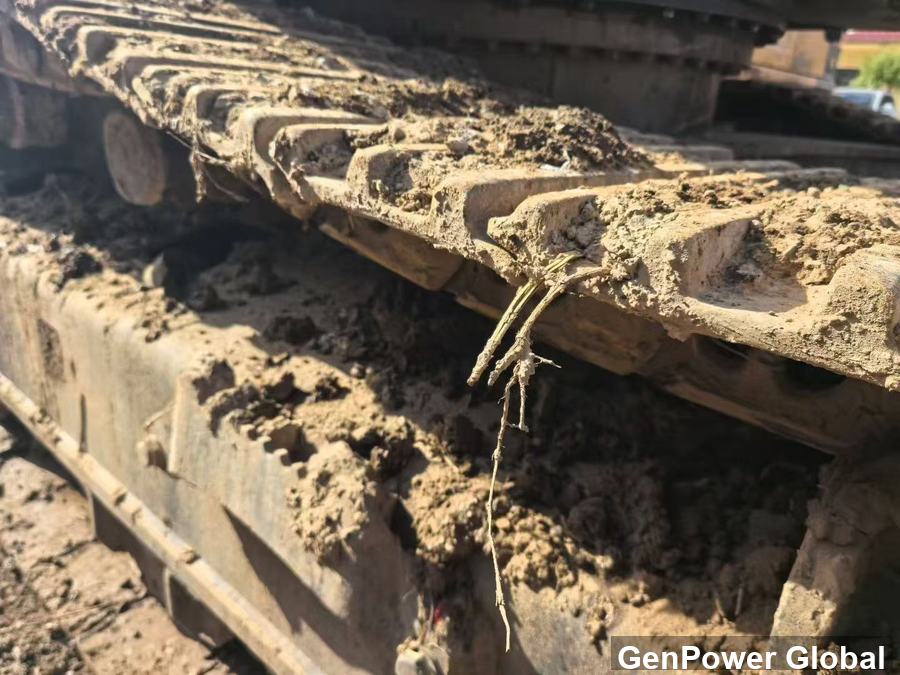
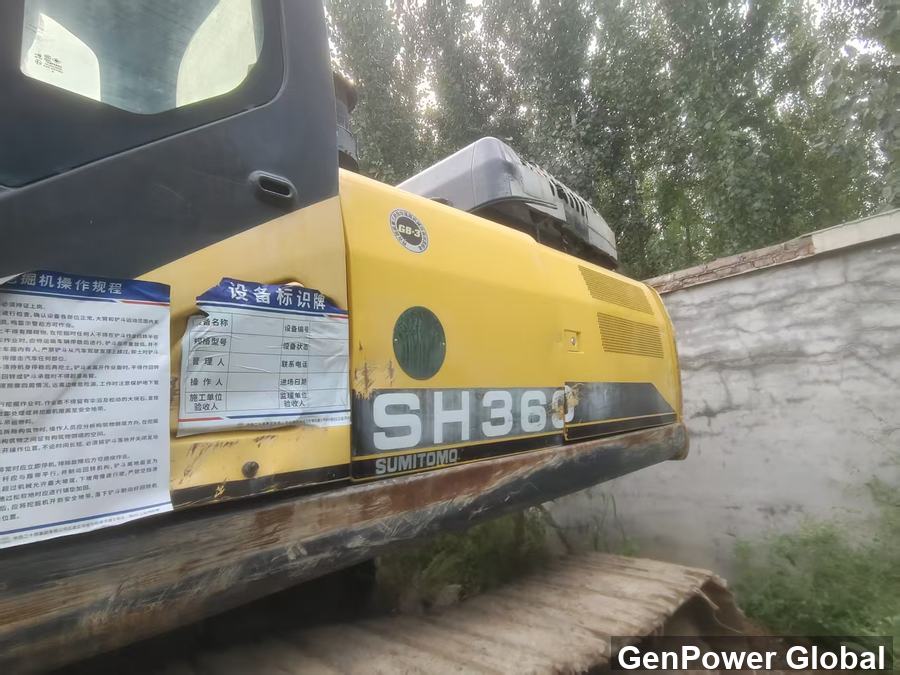
Undercarriage. On tracked machines this is the biggest single budget line after purchase. Ask for the wear percentage in writing, and photograph the links, rollers and idlers yourself — our SH360 page carries the undercarriage as found, mud included. Pins and bushings. Boom, stick and bucket linkages develop play you can feel with a crowbar and see in a cycling video. Hoses. Calendar age plus heat cycles: a seven-year-old machine is one budget line from a hose set regardless of hours. Pump efficiency. You feel this before you see it — slow cycle times, hot returns. A pressure test is cheap relative to the money at stake. Swing and structure. Swing backlash, and cracks or repairs around boom root welds and the counterweight. On our unit the counterweight paint wear is photographed honestly rather than resprayed — fresh paint on a working machine is information too, just not the kind sellers intend.
The practical way to run this list remotely is to collapse it into one appointment. Ask the seller for a single dated video that walks the machine: start-up from cold with the meter in frame, a full cycle at working speed, swing through its full arc both ways, the undercarriage walked end to end on both sides, and the engine bay opened for the plate and the oil fill. Ninety seconds of honest footage answers more than an afternoon of messages, and it gives your mechanic something specific to review before you commit to an inspection trip or a deposit. If a seller will only send stills, take the stills — but price the video you did not get, because on a five-digit-hour machine the things video catches are precisely the things stills are chosen to hide.
3. Why the engine plate is the quiet hero
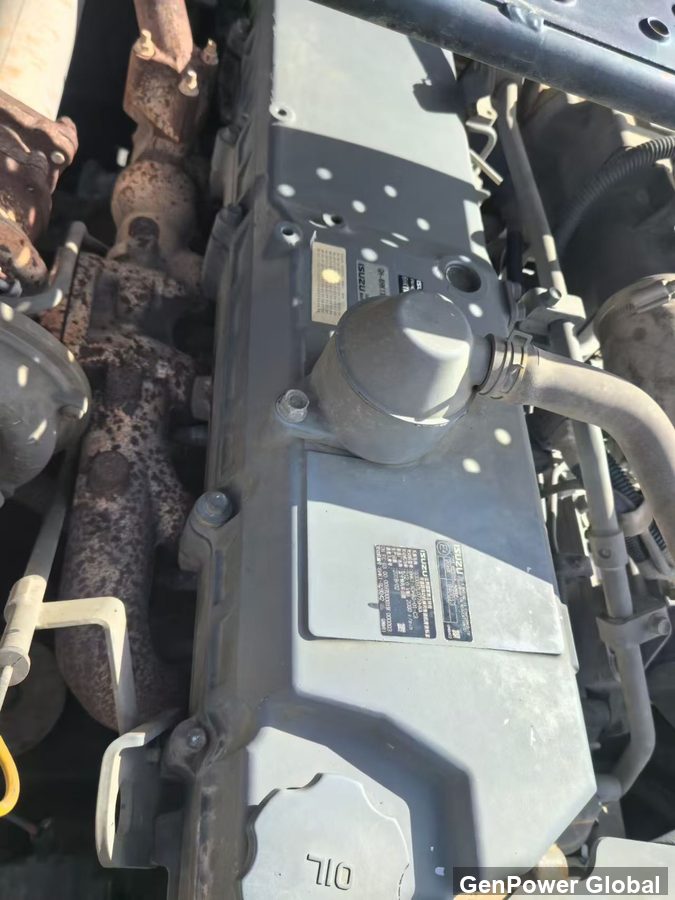
Every listing we publish carries its plates, and on high-hour machines the engine plate does more quiet work than any other photo. The SH360’s Isuzu plate reads the model — 6HK1, type 6HK1-XHG-01-C3 — the rated output of 212 kW class at 2,000 rpm, and, the detail that matters most, a production date of 2019/02. That one line does three things at once: it confirms the engine family a parts man in Nairobi or Lagos can order for in his sleep, it puts a hard floor under the machine’s age claim, and it shows the seller has nothing to hide about where the numbers come from.
What a plate cannot do is prove the hour reading — no photograph can, on any machine at any price. What it can do is make the seller’s story checkable: the plate says 2019/02, the owner says 2019, the badge says SH360, and the GB-3 emissions sticker on the body agrees with the engine’s certified stage. When plate, badge, sticker and story all point the same way, you are no longer buying a stranger’s claim; you are buying a file that hangs together. When they do not agree, you have saved yourself a deposit. Whether the machine is accepted into your destination market is a separate question for your clearing agent, subject to the latest official notice — put the plate and sticker photos in front of them before you commit.
4. High-hour Japanese vs low-hour Chinese: the honest trade-off
Our yard currently holds both answers to the “which digger” question, and they make the trade-off concrete. The 2019 SANY SY215C, a 22-tonne machine at 6,568 hours with full service records, lists at 29,200 US dollars. The SH360 of this guide, a 30-tonne machine at roughly 12,000 hours, lists at 39,400. The Japanese unit costs about a third more and delivers nearly half the tonnage again — and the per-tonne story is the quiet headline: mass is cheap on the used market, but the meter on Japanese iron costs more because the brand’s resale floor is higher.
So which is right for your site? If your fitters already run Isuzu and Mitsubishi engines and your mechanics can rebuild a Sumitomo swing drive, the high-hour Japanese unit converts your parts knowledge into margin. If you are buying into a fleet that is already SANY and XCMG with a container of spares on the shelf, the low-hour Chinese unit keeps your consumables common and your mechanics on familiar ground. What we refuse to do is dress the choice up as a brand verdict: on both machines the purchase test is the same file — wear that agrees with the meter, plates that agree with the story, and a price that sits where the evidence puts it. Buyers who want the 20-tonne version of this argument, including the CAT 320D2 vs PC200 parts-cost comparison, should read our dedicated guide.
Resale thinking belongs in the same calculation, whichever way you lean. The used market does not only price what a machine can do; it prices how easy it is to say yes to. A Japanese badge with a familiar engine carries a floor under its resale that shows up years from now, at exit, in a market of buyers who never spoke to you. A Chinese machine at a lower entry price compensates differently: the absolute money at risk is smaller, and the consumables are cheaper for every hour you own it. Neither route is a trap and neither is a gift — they are two risk shapes, and the right one depends on how long you intend to hold the machine, how you fund it, and what your market will pay for it when you are done.
5. Price: what our stock says about the 30-tonne class
Rather than quote market averages we cannot stand behind, here is the table we can: two documented machines, photographed plate to undercarriage, priced on their own evidence.
| Machine | Year / hours | Indicative FOB China (USD) |
|---|---|---|
| SANY SY215C, 22 t | 2019, 6,568 hrs | 29,200 |
| Sumitomo SH360, 30 t | 2019, approx. 12,000 hrs | 39,400 |
For context on the wider 20-tonne Japanese class, our CAT 320D2 vs PC200 guide tracks indicative bands of roughly 25,000–45,000 US dollars depending on year and hours, with the CAT holding its premium on resale. The SH360’s number sits where its evidence puts it: mid-band for the class, priced for its hours but supported by the plate, the sticker and an undercarriage we photograph rather than describe. Every figure here is indicative and subject to a live quote; landed cost adds flat-rack freight, marine insurance, duty and VAT, which the 20-tonne guide breaks down layer by layer and which apply in similar proportion at 30 tonnes.
One shipping note specific to this class: at roughly 30 tonnes the SH360 does not fold into a container. It moves on a flat rack or break-bulk, which means freight is quoted per shipment rather than per box, and vessel space for over-height, over-width cargo swings with the season. Practical consequences worth budgeting: book the flat rack before the deposit rather than after, confirm your port can discharge the unit, and expect the total freight line to be a material fraction of the machine’s price rather than a rounding error. None of this is a reason to avoid the class — it is a reason to involve your clearing agent early and to ask us for a CIF number tied to a real sailing rather than a percentage applied to the FOB figure.
6. Red flags specific to high-hour listings
High hours attract a particular kind of dressing-up. Run this list on any five-digit-meter listing, ours included:
1. A meter that reads too well. 12,000 honest hours beat 4,000 explained hours; a reading that contradicts the wear is the single loudest alarm. 2. Fresh paint on the undercarriage. Nobody sprays rollers for fun; paint there is hiding percentage points of wear. 3. “Just rebuilt” without receipts. A rebuilt pump or engine is a real value add — with an invoice, a warranty and a name behind it. Without paperwork it is a story. 4. Missing plates. An excavator whose engine plate or serial plate photo is absent from the listing is asking you to buy an assumption. 5. A work story that shifts. Quarry last month, municipal last year, imported yesterday — the story must survive the same arithmetic as the meter. 6. No video. On a high-hour machine the start-up, swing and dig video is not a nicety; it is the cheapest inspection you will ever get. A seller who will not produce it has told you the price of everything else.
Is 12,000 hours a lot for a 30-tonne excavator?
Yes - it is genuinely high, and we say so on the listing. A 2019 machine at roughly 12,000 hours has averaged about 1,700 hours a year, which is steady commercial work rather than a hobby unit. The good news is that a 30-tonne Japanese machine was engineered for exactly this duty: with documented care, the 6HK1 engine and the Sumitomo driveline routinely pass 20,000 hours. What decides the purchase is not the number but whether the wear agrees with it.
How do I verify the hours remotely before paying a deposit?
Ask for one continuous, dated video: the machine starting cold, swinging, and digging a full cycle, with the hour meter visible at the start and the serial plate visible at the end. Cross-check the reading against pedal and seat wear, undercarriage wear percentage, cutting-edge condition and any service stickers. A photograph of a meter taken in a different yard on a different day proves nothing; a genuine seller produces the video within a day.
What does a used 30-tonne excavator cost FOB China?
It moves with year, hours and paperwork. Two real anchors from our yard: the 2019 SANY SY215C 22-tonne at 6,568 hours lists at 29,200 US dollars, and the 2019 Sumitomo SH360 30-tonne at roughly 12,000 hours lists at 39,400. For the 20-tonne Japanese class, our CAT 320D2 vs PC200 guide tracks indicative bands of about 25,000 to 45,000 depending on year and hours. Every figure is subject to a live quote.
Should I buy a high-hour Japanese machine or a low-hour Chinese one?
Both can be the right answer, and the badge is the least of it. The high-hour Japanese unit gives you a proven driveline and deep parts knowledge at a price per tonne that Chinese iron cannot match; the low-hour Chinese unit gives you a fresher meter and newer cab for less money in absolute terms. Decide by your parts ecosystem, your operator's habits and the job profile - then buy whichever unit's wear, paperwork and price agree with each other.
What wears out first on a 12,000-hour machine?
In rough order of cost: the undercarriage (ask for the wear percentage in writing), the pins and bushings on boom, stick and bucket, the hose set (calendar age plus heat cycles), and hydraulic pump efficiency, which you feel as slow cycle times before you see anything. Swing backlash and engine blowby are the two checks that separate a well-kept 12,000-hour machine from a tired one wearing its number.
What documents come with a shipment from you?
A commercial invoice showing the serial number, packing list, bill of lading details, certificate of origin, and a no-asbestos declaration where the destination requires one. Kenya-bound units normally add a PVoC certificate of conformity arranged before shipment; Nigeria clears through Form M and PAAR. We prepare and document; whether the machine is accepted into your market is decided by the destination authority and your clearing agent, subject to the latest official notice.
The short version
A 12,000-hour excavator is not a bargain and not a write-off — it is a machine whose story must survive arithmetic and wear inspection, and at the right price it often does. Our 2019 SH360 carries roughly 12,000 hours on owner records at 39,400 dollars FOB, with the Isuzu plate, the GB-3 sticker, the pumps and the undercarriage all photographed on the detail page; the meter photo and dated video complete the file before any deposit moves. Compare it with the rest of the excavator stock, read the 20-tonne comparison if that is your class, and for the full photo file and a CIF number, send us your port. General export questions are answered on our FAQ page.
Prices, dates and wear notes in this guide are 2026/2027 references checked against the machines in our yard; every figure is subject to a live quote and the latest official notice of the relevant authorities.