No Badge, No Guesswork: Buying a Used 300 kW Generator When the Data Plate Is Missing (2027 Guide)
Most buying guides teach you to read a nameplate. This one is about the set that has none. A 300 kW silent genset came into our yard in a yellow canopy with a stencilled yard number, a complete engine bay and not one manufacturer’s badge anywhere on it — no badge, no data plate, no meter photograph. The owner’s records say 300 kW, electronic-injection Shangchai, Bofa pure-copper brushless alternator, about 5,000 running hours. We listed exactly that, marked every one of those figures as a record rather than a verified fact, and priced the set at USD 9,300 FOB China. This guide explains why that is the honest way to sell it — and how a buyer should interrogate a plate-less genset instead of walking away from one.
1. The unit, and the plate that isn’t there
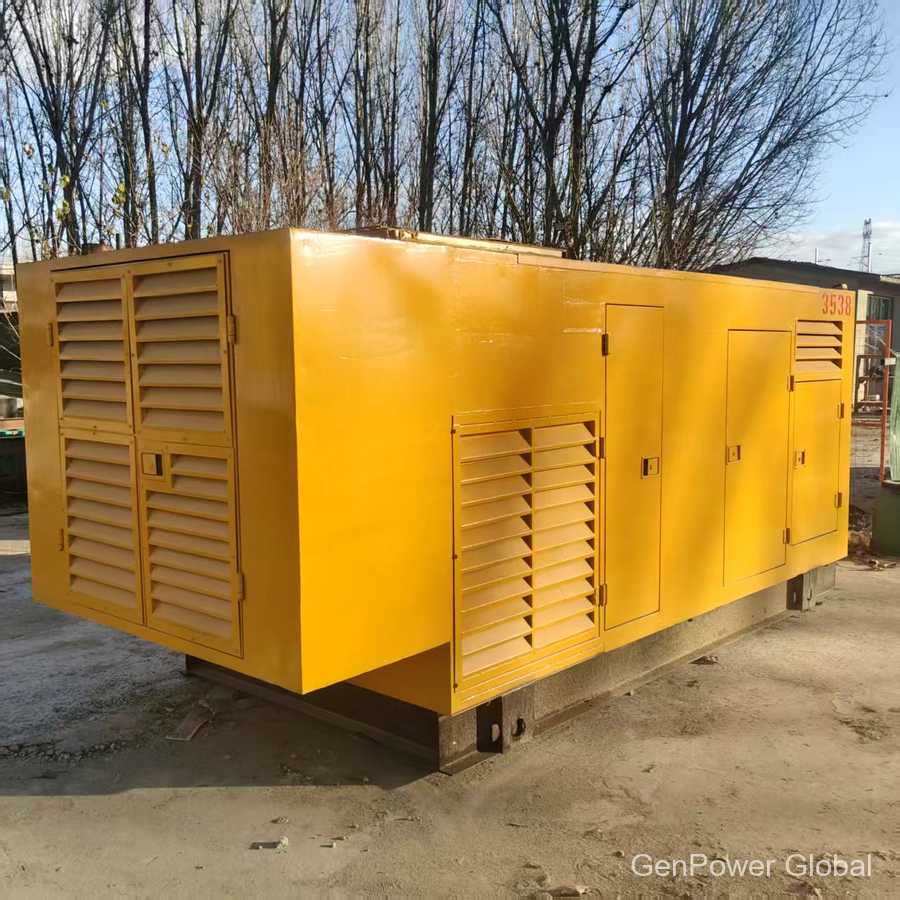
Start with what the photographs actually show, because that is where every honest listing begins. The canopy is a fabricated acoustic enclosure in industrial yellow: louvred ventilation panels on the gable end and along the side, four full-height access doors on lift-off hinges, flush latches, lifting points at the roof corners. The paint is original rather than a quick blow-over — the louvre edges still show their factory fold lines and the door gaps are even. On the upper right-hand panel, in red stencil, the number 3538: a yard or fleet number, the kind of marking an equipment owner uses to count his own machines rather than the kind a factory applies to identify a model.
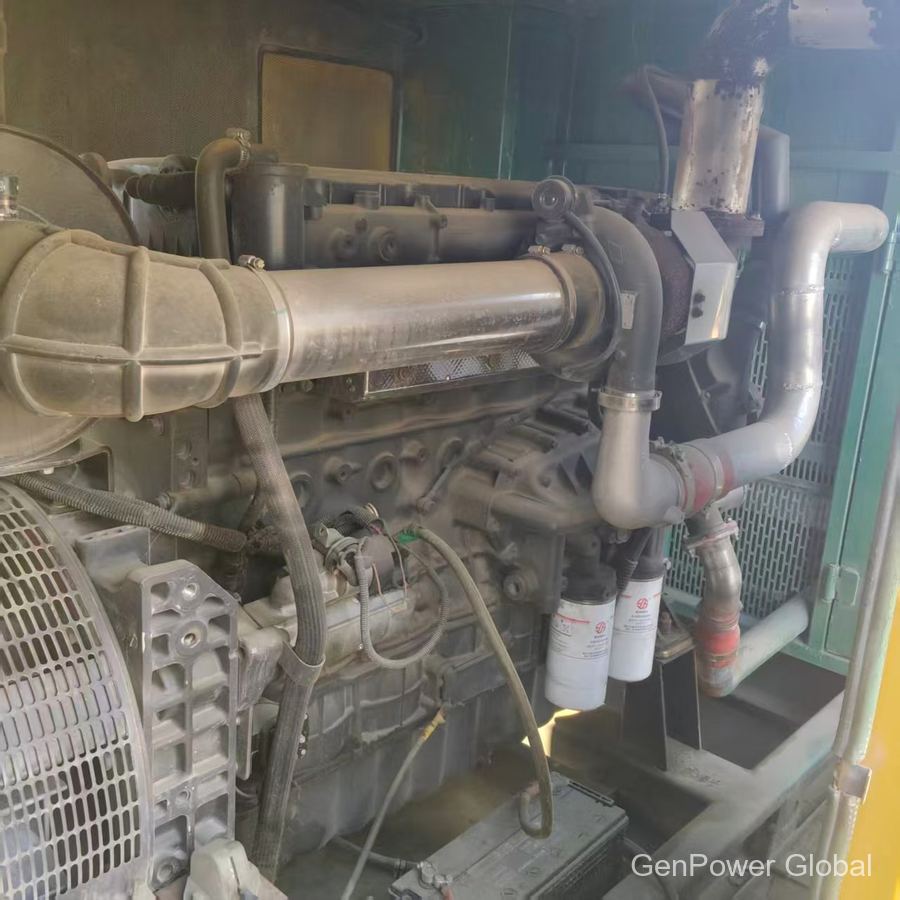
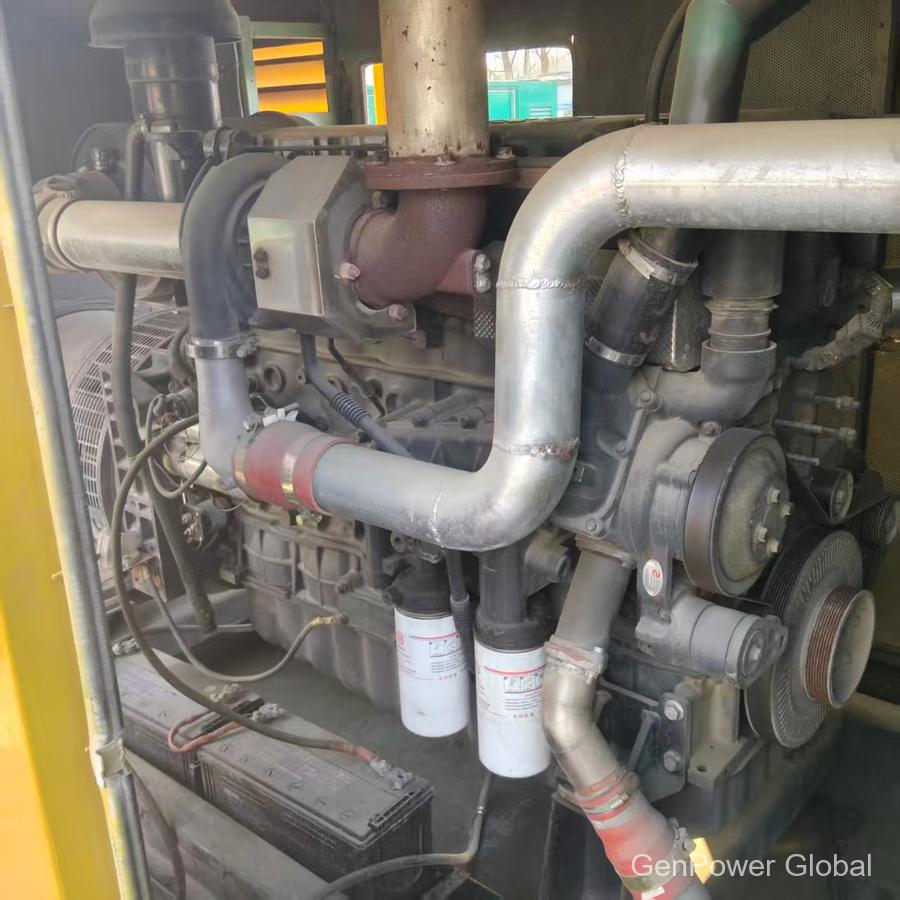
Open the doors and the engine bay is complete. A six-cylinder diesel sits on the skid with its charge pipe along the top, twin spin-on filters hanging at the block’s lower edge, a starter and battery box below, and the exhaust routed up through the canopy roof with a lagged section and a flexible bellows. No missing covers, no cut hoses, no parts borrowed and not returned.
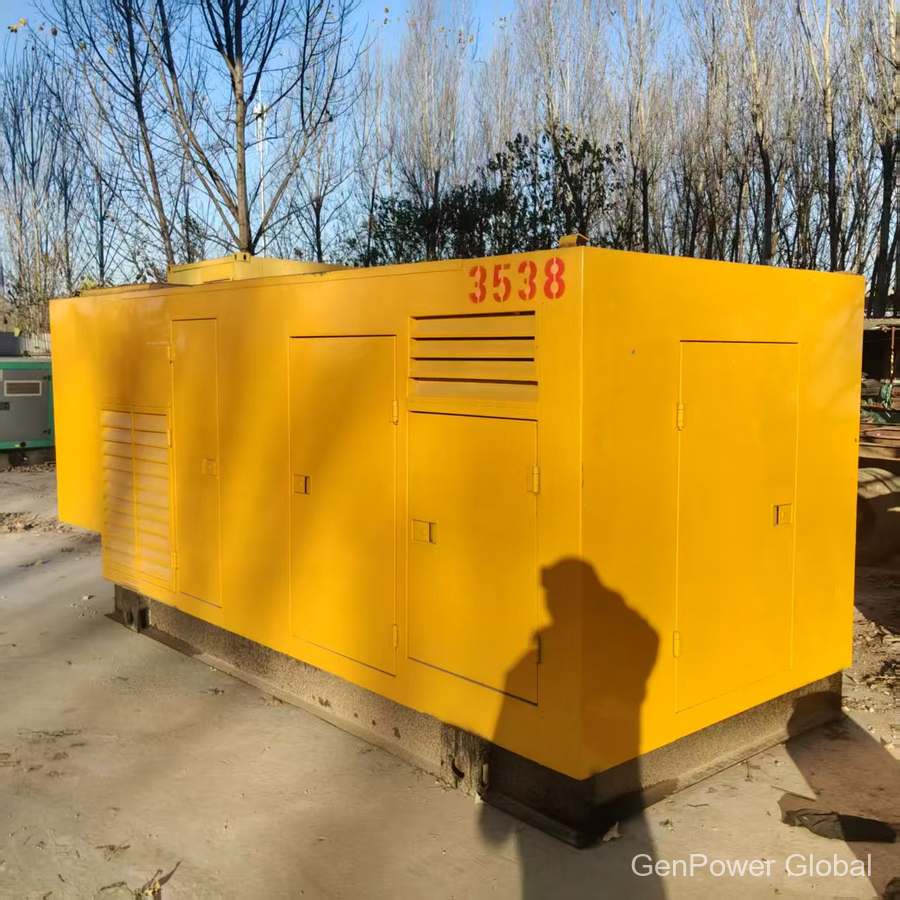
What is absent matters just as much. There is no set-maker badge on the canopy — no PowerLink-style plate, no Bofa decal, no assembler’s name. There is no data plate riveted to the frame, which is where a genset’s kVA, voltage, frequency, current and serial number normally live. And there is no photograph of the controller display, so the hour figure has no instrument behind it yet. Three absences, one sentence each on the listing, and a price that reflects them. That is the whole method: the gaps go on the page, not into the imagination.
2. What the photographs can and cannot prove
It is worth being precise here, because “we have photos” has become a phrase that means very little on the used-equipment market. Four real photographs of this set establish a defined list of facts: the machine exists and stands in a yard with other equipment rather than in a stock image; the canopy is complete — doors, latches, hinges, louvres and lifting points all present, which is the most expensive thing to replace on a silent set after the engine; the engine bay is assembled rather than cannibalised; the internal scale is consistent with the 250–350 kW class, since canopy proportions, six-cylinder block, radiator size and twin filters all sit in that band; and because the same yard number appears in more than one frame, the photographs describe one machine rather than a collage.
They do not prove the rating, the engine model, the alternator make, the year, the running hours or the running condition. No photograph can, without a plate or a meter in the frame. The honest formulation, and the one we use on the detail page, separates the two lists: canopy and engine bay photographed; rating, engine, alternator and hours per owner records; nameplate and meter photographs available on request.
There is a commercial argument here too. A plate-less set sold with confident numbers creates a dispute the moment the buyer’s engineer opens the terminal box and finds aluminium, or the controller shows 9,000 hours rather than 5,000. A set sold with stated gaps creates a conversation instead — and the price already carries the missing paperwork.
3. Shangchai + Bofa: the pairing inside most Chinese 300 kW sets
“Shangchai engine, Bofa alternator” is not a brand name — it is a recipe, and understanding the recipe is how you evaluate a set whose badge has gone missing. Chinese generating sets in this class are almost always assembled from bought-in components: an engine from one factory, an alternator from another, a controller from a third, a canopy from a body builder. The name on the door, when there is one, usually belongs to the assembler — the smallest player in the chain. The engine and the alternator determine whether the set is worth anything in ten years, and they are also the two components you can identify without any badge at all.
Shangchai — Shanghai Diesel Engine, trading today as SDEC — is one of the oldest and largest diesel builders in China, and its D- and H-series six-cylinders sit inside a very large share of domestic sets between roughly 150 and 400 kW. The electronic-injection versions replace the mechanical inline pump with an ECU-controlled system: fuel quantity and timing are computed rather than set by a governor spring, giving cleaner combustion, better part-load fuel consumption and easier cold starting. The trade-off is diagnostic dependence — when injection drifts you need a scan tool and someone who can read codes. In most export markets that capability exists: SDEC’s dealer network and the independent aftermarket both stock sensors and injectors.
Bofa is a Chinese alternator manufacturer whose brushless synchronous machines are sold under its own name and as the alternator inside other people’s sets — including the two documented BF-300GF units already in our stock. Brushless means excitation reaches the rotor through a rotating rectifier rather than carbon brushes and slip rings, so there is nothing to wear and nothing to arc. Pure copper windings are the other half of the claim, and they matter: aluminium-wound alternators are cheaper and lighter, but carry higher resistance, run hotter and must be derated for continuous duty, which is why a “300 kW” set with an aluminium alternator may only be good for 250 kW at prime power in a hot climate.
Which brings the argument back to the plate that is missing. The rating of a genset is not a property of the canopy; it is the lower of what the engine can deliver continuously and what the alternator can accept, at a stated ambient temperature and power factor. Without a data plate, “300 kW” has to be triangulated from iron — which is what section six walks through.
4. The evidence ladder we publish by
Every listing on this site sits somewhere on a three-rung ladder. The top rung is photographed identification: a data plate, a model badge, an hour meter, an engine plate — images any buyer can read and check. That is where the FG Wilson P550E3 sat, with its model code photographed on the base frame, and where our Sumitomo SH260 sat, with a dated photograph of the monitor reading 7,986.5 hours. The middle rung is owner records: figures the seller states, published as stated, never dressed as verified. The bottom rung is documents on request: photographs and test evidence promised before money moves, named explicitly so the buyer knows what to ask for.
This 300 kW set sits on the middle rung with one foot on the bottom: rating, engine, alternator and hours are owner records; nameplate, engine number and meter photographs are promised on request. That is a lower position than the FG Wilson, and the listing says so in the first screen, not in a footnote. What it is not is a lower standard. The standard is that every claim carries its source — and on the FG Wilson, that standard required us to publish a rating lower than the seller’s sheet, because the badge said 440 kW standby where the sheet said 700 kW. A rule that only ever inflates numbers on request is not a rule; it is marketing. A rule that cuts both ways is a specification.
Buyers should apply the ladder to us and to everyone else: ask which rung each phrase in a listing stands on, request the plates, and when they never arrive, treat the silence as the answer it is — which is what we have done here.
5. What a plate-less 300 kW set should cost
The asking price is 66,000 RMB, converted at roughly 7.1 to the dollar for an indicative FOB figure of USD 9,300. The conversion is arithmetic, not a quotation: rates move, and any real number has to be tied to a sailing and a payment route. But the class comparison is instructive, because price per kilowatt exposes what a buyer is actually paying for. Our documented PowerLink 50 kW silent set lists at 4,650 dollars, or about 93 dollars per kilowatt; the FG Wilson P550E3 at 400 kW prime lists at 31,000 dollars, about 77 per kilowatt; the Caterpillar 3412 at 720 kW lists at 35,400, about 49 per kilowatt. This 300 kW set at 9,300 dollars works out at 31 dollars per kilowatt — the cheapest per-kilowatt position in our yard, and roughly level with the heavy industrial end of the curve despite being a mid-size set.
Two forces produce that number, and only one of them is the missing plate. The first is scale: generating sets get cheaper per kilowatt as they get bigger, because the canopy, the controller, the base tank and the assembly labour are largely fixed costs that spread across more output. A 50 kW set is dominated by those fixed costs; a 300 kW set has already diluted them. The second force is documentation. The documented Bofa BF-300GF units in our stock list at 11,200 dollars for the same 300 kW class, about 37 dollars per kilowatt — a premium of roughly 20 per cent over this set. That premium buys a photographed nameplate, a stated year and an identified model — the buyer’s verification risk, priced. A plate-less set at the documented price would be overpriced; at 20 per cent below it, the discount is doing the job a discount should do.
Freight is the friendlier half of this set’s economics. A 300 kW canopy set stands about four metres long and a little over two metres tall, at three to four tonnes — a 20-foot container swallows it without drama, which is not true of the 500 kVA class: one container, one loading, no flat rack, no over-height paperwork. Every figure in this section is indicative and subject to a live quote; a CIF number against a real sailing is one message away.
6. How to identify a genset that has no data plate
This is the practical core of the guide, and it applies to any unbranded set anywhere. Work in the order below; each step either confirms or contradicts the one before it, and three agreeing signals are worth more than any single document.
One: the engine number. Every industrial diesel carries a stamped number on the block, usually on a machined pad on the right-hand side near the front, sometimes behind the injection pump. With that number, the engine maker’s dealer can confirm model, rating and build year — free, in a day, without the seller’s cooperation. This is the highest-value photograph a buyer can request on a plate-less set.
Two: the injection system. Electronic injection is visible. Look for a harness running to the injectors or a rail, a sensor on the pump, and an ECU — a finned aluminium box with multi-pin connectors — on the block or the canopy frame. A mechanical engine has a throttle linkage and a shut-off solenoid and no ECU. If the listing says electronic and the photograph shows a mechanical pump, you have learned something more valuable than any badge.
Three: the alternator. Open the terminal box. Copper winding ends are warm red-brown; aluminium is silver-grey. Read the alternator’s own nameplate on the frame — even unbranded sets normally carry one, giving kVA, power factor, voltage and insulation class. Compare frame size against the claimed output: a 300 kW claim sitting on an alternator that catalogues at 200 kVA is a 200 kW set.
Four: the controller. Deep Sea and SmartGen units are near-universal on Chinese sets in this class; the model number gives the rated current range, and the parameter menu often holds the configured kW, voltage and frequency. The same display carries the hour meter, so one dated photograph of the running screen answers the hours question and the identity question together.
Five: the physical envelope. Canopy length, height and weight at a weighbridge; fuel tank capacity; radiator core area. Crude individually, but together they bound the class tightly: a set that weighs three tonnes with a 300 kW-sized radiator is not a 500 kW machine.
Six: the load test. The only proof that survives all the others. A resistive load bank at 25, 50, 75 and 100 per cent of the claimed rating, with voltage, frequency, coolant and exhaust temperature recorded at each step. If the set holds 300 kW for an hour without overheating, derating or tripping, the number is real. If it sags at 200, you have found the true rating and a negotiation point at the same time.
7. Red flags on no-badge listings
A missing plate is not itself a red flag — plates fall off, get painted over, and are removed by yards that consider them a theft risk. What follows a missing plate is where the danger lives. 1. No plate and no engine number. If neither can be produced, you are being asked to buy an identity-free machine; walk. 2. Fresh paint over everything. New paint on the block and the canopy at the same time usually hides corrosion, oil weeping or a welded repair — look for paint on hose clamps and bolt heads, which is the tell. 3. Hours claimed with no meter photograph. On a set with a controller, that is a five-second photo; refusing it is an answer. 4. “Pure copper” with no terminal-box photograph. The claim costs nothing to make and one picture to prove. 5. A price far under the class. A 300 kW set at half the documented band is either a smaller machine, a set with borrowed parts, or a machine with a story that will not survive a lawyer. 6. A rating that the alternator cannot carry. Compare the alternator nameplate to the claim; the lower number is the truth, and it is usually the alternator.
Why would you list a generator that has no nameplate at all?
Because a machine with honest gaps is more useful to a buyer than a machine with invented certainty. The set is real, it is in our yard, it is photographed from four angles, and the price is a real number. What it does not have is a data plate, so the rating, the engine model and the running hours are published as owner records rather than as verified facts, with the nameplate and meter photographs promised before any deposit. Buyers can then decide with the gaps visible, and we can close those gaps as documents arrive. The alternative - filling the blanks with plausible numbers - is how listings become fiction, and it is the one habit we do not allow on this site.
Is 5,000 hours a lot for a 300 kW diesel generator?
No. A 300 kW set of this class is usually built for a service life measured in tens of thousands of hours, so 5,000 hours is roughly the equivalent of a well-maintained truck at 150,000 kilometres - used, but nowhere near end of life. What matters at that figure is not the number itself but the maintenance history behind it: oil and filter intervals, coolant condition, valve clearances on a mechanical engine, injector health on an electronic one, and whether the set ran steady prime duty or intermittent standby. That is why we ask for the meter photograph and a cold-start video rather than accepting a round number.
What does electronic-injection Shangchai mean, and does it matter in Africa?
Shangchai - Shanghai Diesel Engine, now SDEC - builds the D-series and H-series six-cylinder diesels that sit inside a very large share of Chinese generating sets between roughly 150 and 400 kW. Electronic injection means the fuel quantity and timing are controlled by an ECU rather than a mechanical pump, which brings cleaner combustion, better fuel economy at part load and easier cold starting, at the cost of needing diagnostic capability when something drifts. In practice that means a scan tool and a technician who understands the fault codes, and in most export markets the SDEC dealer network and the aftermarket both carry the sensors and injectors. Ask any seller for the engine number stamped on the block: with that number a dealer can confirm the model, the rating and the build year before money moves.
How can I tell whether the alternator really has pure copper windings?
Three checks, in ascending order of certainty. First, the terminal box: open it and look at the winding ends and the jumpers - copper is a warm red-brown when clean and develops a green patina when oxidized, aluminium is silver-grey and stays grey. Second, the weight and the kVA-to-frame ratio: copper machines are heavier for the same output, and a 300 kW alternator that looks small for its rating is usually a derated aluminium unit. Third, the alternator nameplate on the frame - even unbranded sets normally carry one, showing kVA, power factor, voltage, insulation class and sometimes the winding material. A seller who claims pure copper should be able to photograph all three; if none of them can be produced, price the set as though the windings are aluminium, because that is the safe assumption.
Can a 300 kW silent set ship inside a container?
Usually yes. A 300 kW canopy set of this build sits on a skid roughly four metres long, around 1.5 metres wide and a little over two metres tall, and weighs in the region of three to four tonnes - comfortably inside a 20-foot container's internal dimensions and payload. That is a real advantage over the 500 kVA class, where the set often needs a flat rack or break-bulk. The practical points are lashing, blocking the skid against forward movement, and leaving the fuel tank drained to the level your carrier allows. Ask for a CIF quote tied to a specific sailing rather than a generic freight estimate, because container rates move and the loading window is what determines the landed cost.
What should a used 300 kW Chinese genset cost FOB China?
Our documented 300 kW Bofa sets list at 11,200 US dollars FOB; this unbranded, plate-less unit lists at 9,300 US dollars (66,000 RMB, conversion indicative and subject to a live quote) - about 31 dollars per kilowatt against roughly 37 for the documented units. That gap is not a discount for charm: it is the market price of missing paperwork. A set whose rating, engine and hours are all owner records is worth less than an identical set whose plates are photographed, because the buyer carries the verification risk. Treat any plate-less 300 kW set priced above the documented band as overpriced, and any set priced far below it as a machine whose identity needs explaining before the deposit.
The short version
A used genset without a data plate is not un-buyable — it is un-verifiable until you do the work, and the work is knowable. Our 300 kW silent set, Shangchai-powered and Bofa-alternatored per owner records, approximately 5,000 hours, is listed at 9,300 US dollars FOB with its canopy and engine bay photographed, its gaps stated on the page, and its nameplate, engine number and meter photographs promised before any deposit. That is roughly 31 dollars per kilowatt against 37 for our documented 300 kW units — a discount that pays the buyer for the verification he is about to do. See the full photo file, compare the documented sets in stock, read the small-genset checklist and the Chinese-brand guide, and for a CIF number tied to a real sailing, send us your port.
Prices, ratings and model data in this guide are 2026/2027 references; every figure is indicative, subject to a live quote and the latest official notice of the relevant authorities. Owner-recorded specifications are published as recorded and are confirmed against nameplate photographs before shipment.