Badge Beats Brochure: Buying a Used FG Wilson P550E3 — Why the Model Code Settles Arguments (2027 Guide)
Every used machine has two stories: the one on the seller’s sheet and the one stamped into the iron. This week the two disagreed. A big blue open genset arrived in our yard with a file that said 700 kW — and with a base frame that said FG Wilson P550E3, a model code whose factory rating is 500 kVA / 400 kW prime and 550 kVA / 440 kW standby. We listed the machine at its badge rating, noted the sheet’s figure as a difference, and priced it on the evidence: USD 31,000 FOB China. The story of that decision is the most useful generator lesson we have published, because the same argument happens on every continent every week — and the badge wins every time it is allowed to speak.
1. The unit, and the badge that settled an argument
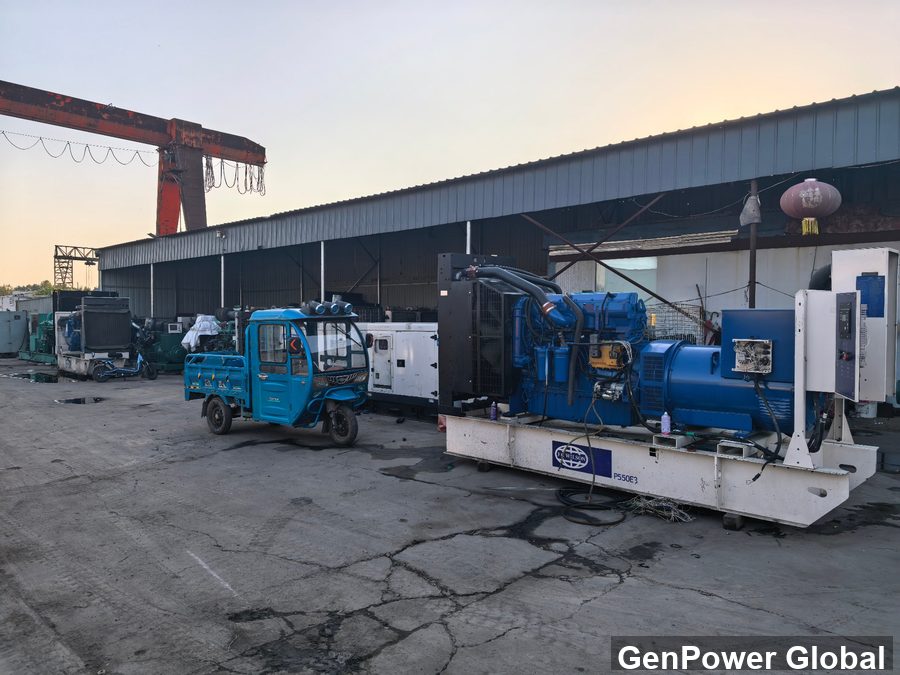
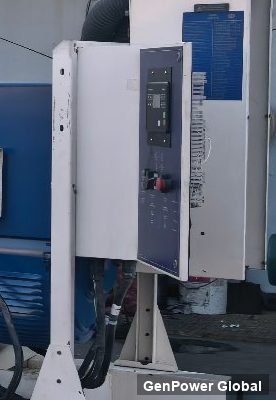
First the machine. It is an open-skid set — no canopy — on a heavy welded steel base, painted in the blue that both Perkins 2000-series engines and their packaging houses favour. The engine is a six-cylinder turbocharged diesel with an air-to-air charge cooler; the alternator end carries a vented bell housing and a terminal box; the wall-mounted control cabinet stands on its own posts beside the set, breakers forward. Nothing about the yard photograph is dressed up: hoses on the ground, a trike parked past the crane bay, the set exactly as we found it.
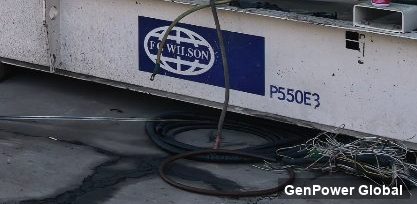
Then the badge. On the white base frame, under the globe-in-oval logo, the model code reads P550E3 — photographed, cropped, and published on the detail page at readable size. That single line of text does more work than the whole spec sheet it contradicts, because model codes are expensive things to fake casually: they are stamped or decaled at the factory, they tie into parts catalogues, and they can be checked against the manufacturer’s published data in seconds. A sheet of paper is written by whoever wants the sale; a model code is chosen by whoever built the machine.
2. What the P550E3 model code actually says
Decoded from FG Wilson’s published data, the P550E3 is a 50 Hz genset running at 1,500 rpm: 500 kVA / 400 kW prime, 550 kVA / 440 kW standby, driven by the Perkins 2506A-E15TAG2 — a 15.2-litre, in-line six with turbocharging and air-to-air aftercooling — and closed on a Leroy Somer alternator per the factory build. The code itself explains its arithmetic: P for the Perkins power plant, 550 for the standby kVA class, E3 for the emissions-generation revision. Voltage variants for this family include 415/240 and 400/230 at 50 Hz, consistent with the 240/400V figure in this set’s file.
So where did 700 kW come from? Honest answers exist: a memory of a bigger sibling (the P800/P900 class sits one badge up), a habit of quoting engine-block output instead of generator output, or simply a sheet carried over from another machine in the same fleet. None of these makes the seller a villain — sheets drift, especially on units that have changed hands twice — but none of them changes the iron. The listing therefore says what the badge says, marks the owner’s figure as a recorded difference, and lets the genset nameplate photo, when it enters the file, be the final word. That is the same hierarchy we applied to a loader’s hours-versus-year arithmetic and an excavator’s nameplate-vs-story contradiction: stamped evidence first, quoted claims second, and the difference documented rather than smoothed over.
Buyers should steal this habit outright. Any genset claim — ours included — can be checked in one step: photograph the badge, decode the code against the maker’s public data, and the power, the engine family and the frequency are no longer a matter of negotiation. It costs one message and saves the price of the wrong machine.
3. Open skid or canopy: choosing the right body
An open set is not a canopy set with parts missing — it is a different buying decision. The P550E3’s open body makes sense when the machine will live indoors: a plant room, a generator house, a fenced compound with a roof. There you get the identical engine, alternator and base for less money, service access you can walk around, and heat that escapes instead of accumulating in rockwool. The canopy earns its premium when the set stands in the weather — rental fleets, roadside telecom sites, mobile contractors — where the enclosure is the only thing between the alternator and the rainy season.
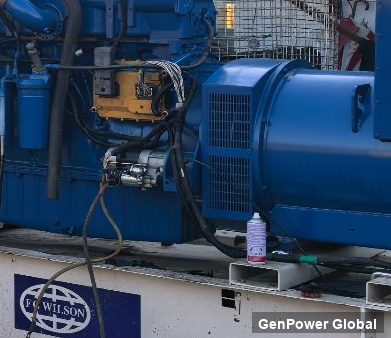
This unit’s file describes the body accurately: open skid, no canopy, wall-mounted cabinet standing on its own posts. For a buyer with a generator house — the typical hotel, factory or cold-store installation across our export markets — that is the configuration the building already pays for, and the money saved against a silent equivalent funds the house’s ventilation, which the set needs anyway. For everyone else, the canopy alternatives in our stock list carry the same philosophy: the badge photographed, the configuration stated, the numbers tied to evidence.
Noise regulation deserves its own sentence in the decision, because it is where open sets get buyers into trouble. A 500 kVA open diesel at one metre is loud enough that neighbours become regulators quickly: residential compounds, hospital grounds and city-centre sites across our export markets increasingly enforce noise limits that an unenclosed set simply cannot meet without a purpose-built acoustic room. The honest test is the site plan, not the price gap — if the set will stand within fifty metres of bedrooms, classrooms or consulting rooms, budget for the building (walls, roof, intake and discharge attenuators) before budgeting for the machine, and if that building does not exist, the canopy from the start is the cheaper path. Buyers who run this check before offering rarely regret it; buyers who run it after commissioning always do.
4. What a used P550E3 should cost
The market anchor first: used P550E3 units offered publicly inside China have asked in the region of 250,000 RMB for older (2007-vintage) examples. Against that band, our unit’s USD 31,000 FOB (≈220,000 RMB) positions it below the public asking level — a fair-market price for a set whose power rating has been honestly corrected downward rather than optimistically rounded up. That is the quiet dividend of the badge-first policy: a machine priced on what it is, rather than on what a sheet wished it were, needs no discount to justify itself — the photograph does the justifying.
Context from our own documented stock shows where this set sits in the class curve. The 300 kW Bofa silent sets list at USD 11,200; the 900 kVA CAT 3412 at USD 35,400; the 550 kVA P550E3 at USD 31,000 — between them in iron, and priced between them in money. Why does the FG Wilson carry a CAT-3412-adjacent price at half the kVA? Brand parts ecosystem, engine desirability, and the fact that 500–600 kVA is the single most demanded standby class for serious installations. Every figure here is indicative and subject to a live quote; a CIF number tied to a real sailing is one message away.
Shipping, at least, is the easy part of this unit’s file. An open P550E3 sits on a base roughly 3.7 metres long and weighs under five tonnes wet — it rolls into a 20-foot container with its cabinet packed alongside, lifts off at the destination port with a forklift, and needs no flat rack, no break-bulk berth and none of the over-height paperwork that canopy sets of this class sometimes trigger. That logistics simplicity is worth real money on the landed cost, and it is one more reason mid-size open sets keep finding buyers who calculate the whole journey rather than the sticker: container freight, port charges, duty and the forklift day are all knowable in advance, and the set’s own base frame is its last mile.
5. The pre-payment checklist for an open genset
Open sets expose everything, which makes them pleasant to inspect and important to inspect fully. One: the badge. Photograph the model code; decode it before offering. Two: the plates. Genset nameplate and engine plate, which must agree with each other and with the badge — on our unit both enter the file before any deposit. Three: the hours. Controller display photographed and dated; on a set this size the meter lives in the cabinet. Four: the cabinet and cabling. Breakers intact, terminals marked, insulation un-melted, no smell of cooked resin — an open set’s electrical side is visible and therefore accountable. Five: the weather path. Base fuel tank sound, radiator unbent, exhaust flange present, and a plan for the set’s roof, because the machine is leaving ours without one.
The load test finishes the file, as it does on every genset we ship: start-up, voltage and frequency under real load, recorded dated before shipment on request. An open set makes this video more convincing, not less — nothing between the camera and the running iron — and serious buyers should make it a standing condition of any offer, on this class as on the small silent sets and the big open skids alike.
6. Red flags: when a listing fights its own badge
Run this list on any genset listing, ours included. 1. A power figure with no model code. “700 kW generator” with nothing stamped anywhere is marketing, not specification. 2. A badge and a sheet that disagree. One of them is wrong; the badge is the one that cannot be rewritten at a desk. 3. A badge from a different maker than the engine. FG Wilson bases carry Perkins or Caterpillar power per their codes; a mismatched pairing needs a repower story with paperwork. 4. A repainted base. The model code lives on the base; paint it over and the set loses its identity — ours wears its yard dust precisely so the code reads. 5. No nameplate photos in the file. A seller who owns the machine owns the plates; producing them costs an afternoon. 6. A price that ignores the rating. If the badge says one class and the price says another, ask which one you are buying — the answer should already be on the page.
What exactly is an FG Wilson P550E3?
It is one of FG Wilson's best-known mid-range open gensets: 500 kVA / 400 kW at prime rating and 550 kVA / 440 kW standby, at 50 Hz and 1,500 rpm, powered by the Perkins 2506A-E15TAG2 - a 15.2-litre, six-cylinder turbocharged and air-to-air aftercooled diesel - with a Leroy Somer LL6114F alternator per factory data. The model code carries the rating: P for Perkins-powered, 550 for the 550 kVA standby class, E3 for the emissions-generation revision. Our unit's globe logo and P550E3 code are photographed on the base frame, which is how the model was confirmed.
Why does your listing say 440 kW when the seller's sheet said 700 kW?
Because the badge outranks the brochure. The set's own base frame carries the FG Wilson logo and the P550E3 code, and the factory data for that model is unambiguous: 550 kVA / 440 kW standby, 500 kVA / 400 kW prime. A spec sheet that disagrees with the stamped model code is, in our experience, describing a different machine, a rounding habit, or a wish. We listed this unit at its badge rating, noted the seller's figure as a difference, and priced the machine as documented - the same discipline we apply to excavator nameplates and loader hour meters. If the genset nameplate photo, when it arrives, proves us wrong, we will correct the listing publicly.
Is an open-skid genset the right choice for a site in Africa?
It depends on where the set will live. An open P550E3 is the right buy when the machine will sit in a plant room, a generator house or a fenced compound with its own shelter: you get the same engine, alternator and base for less money, better service access, and less trapped heat. A canopy is the right buy when the set works outdoors exposed - rental duty, roadside telecom sites, mobile work - because the enclosure is what stands between the alternator and the rain. Buying a canopy for a set that will live indoors is paying for insulation you already have; buying an open set for a set that will stand in the rain is saving money you will spend twice. Our stock carries both bodies, and the 50kW checklist guide on our blog covers the silent-canopy side.
What should a used FG Wilson P550E3 cost FOB China?
Our unit lists at 31,000 US dollars FOB China (about 220,000 RMB; conversion indicative and subject to a live quote). For context, used P550E3 units offered publicly inside China have asked in the region of 250,000 RMB, so a documented unit priced below that band with a photographed badge and an inspection file is a fair-market position rather than a too-good-to-be-true one. The number that matters is the one tied to a specific set, with its badge, meter and nameplate photographs, before money moves - and a CIF figure quoted against a real sailing.
What should I check before paying for a used open genset?
Five things. The model badge, photographed - it anchors every other claim. The genset nameplate and engine plate, which should agree with the badge and each other. The hour reading on the controller, dated. The cabinet: a wall-mounted or canopy-mounted control panel with intact breakers, clearly marked terminals and no melted smell tells you the electrical side was respected. And a load test on video - start-up, voltage and frequency under load - which we record dated before shipment on request. Open sets additionally deserve a look at whether the base fuel tank is sound and the radiator is unbent, since there is no canopy hiding either.
Is the Perkins 2506A-E15TAG2 a practical engine to run in Africa?
Yes - that is one of the reasons the P550E3 has held its value so well. The Perkins 2000 and 4000 series have decades of service history across the continent, so filters, injectors, turbochargers and overhaul kits are cross-referenced by every serious parts counter, and engineers who have topped-and-tailed one are everywhere. The same logic that favours Perkins badges applies with the model number attached: an engine whose parts ecosystem already exists locally is worth more than a marginally newer engine that must be fed from abroad. Our Chinese-brand generator guide explains when the local-parts argument favours a domestic engine instead.
The short version
Model codes outrank spec sheets because they were stamped by the people who built the machine. Our FG Wilson P550E3 — 400 kW prime / 440 kW standby per the badge and the factory data, open skid, Perkins-powered — lists at 31,000 US dollars FOB with its badge, cabinet and engine photographed on the detail page, the seller’s differing figure documented as a difference, and a dated load-test video available before any deposit moves. Compare it with the rest of the generator stock, read the Nigeria & Kenya price guide for landed-cost context, and for a CIF number tied to a real sailing, send us your port. General export questions are answered on our FAQ page.
Prices, ratings and model data in this guide are 2026/2027 references checked against public manufacturer data and the sets in our yard; every figure is indicative, subject to a live quote and the latest official notice of the relevant authorities.