What a Used 50kW Diesel Generator Should Cost — and What to Check Before You Pay (2027 Guide)
The 50-kilowatt class is where most of the world first meets a diesel generator: the workshop that cannot afford another blackout day, the farm with an irrigation pump, the hotel with twelve rooms and a fridge full of somebody’s wedding food. It is also the class where used purchases go wrong most quietly — a small set is cheap enough to buy on a phone call and cheap enough to regret without ever telling anyone. This week we listed a PowerLink 50kW silent set with a UK Perkins engine at USD 4,650 FOB China, and it is a good moment to write down what this class should cost, what separates a working set from a canopy full of scrap, and how to buy one from another continent without paying for somebody else’s problems.
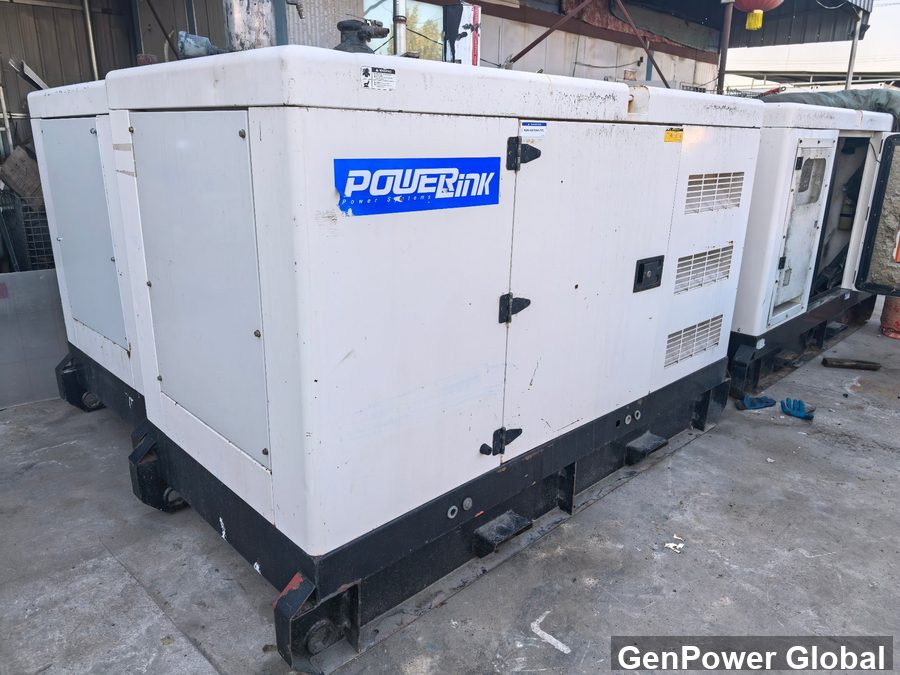
1. The unit: a PowerLink 50kW Perkins silent set
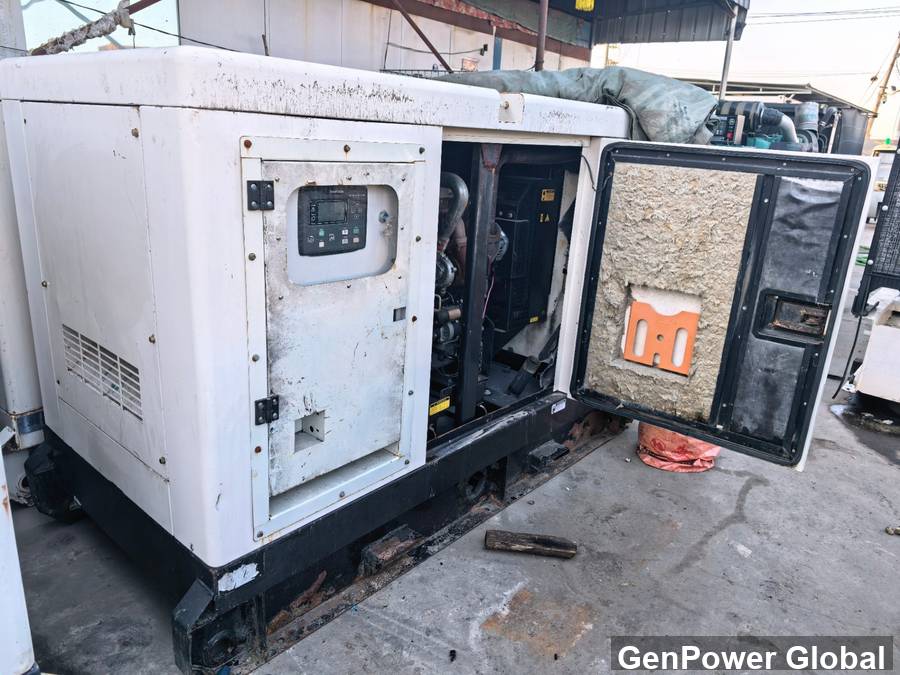
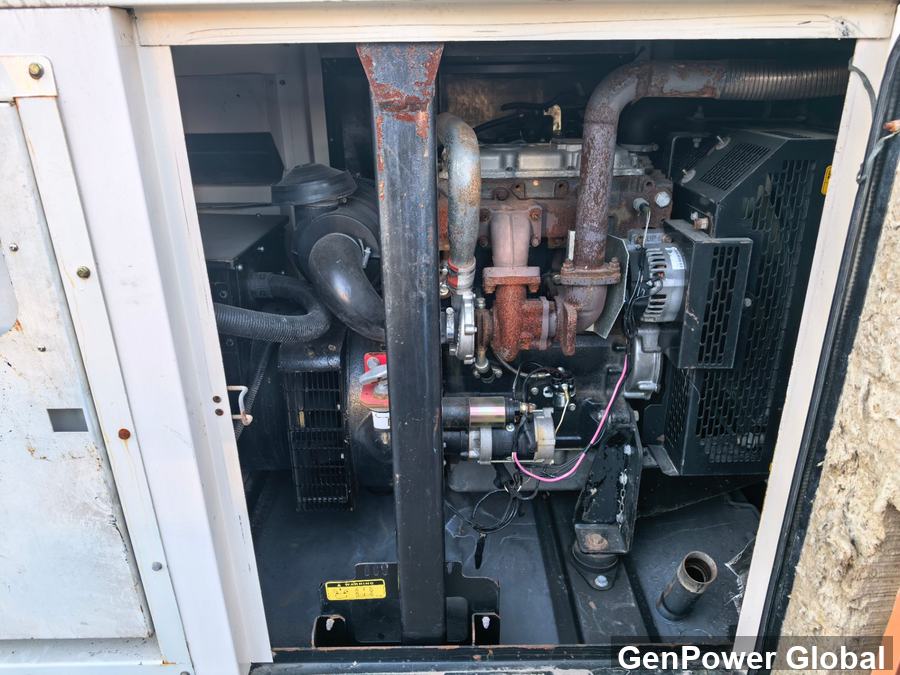
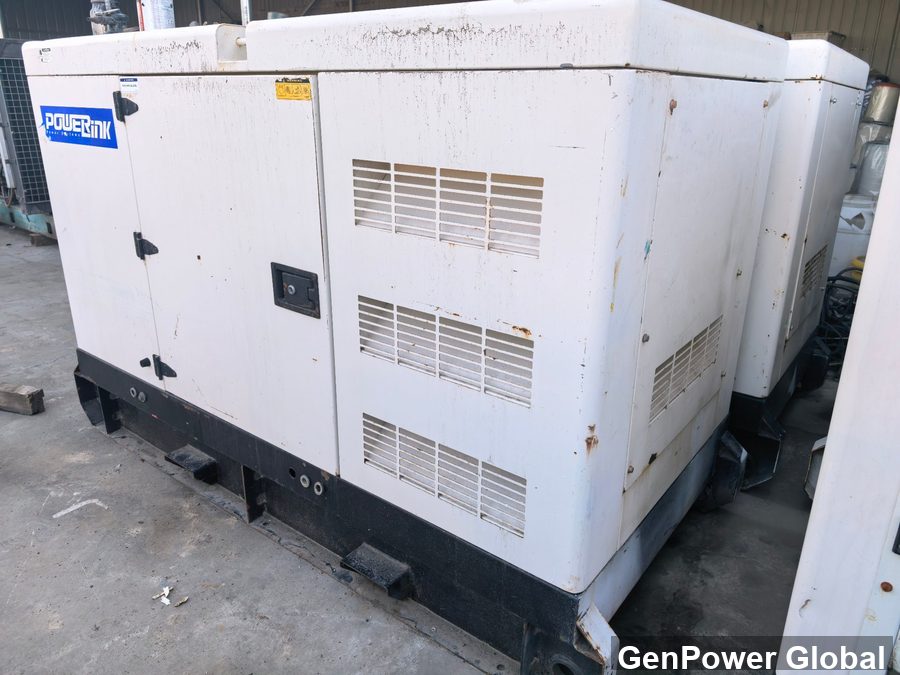
First the machine itself. The canopy carries blue PowerLink branding on both flanks, photographed as found with the honest scuffs of yard life — we do not paint our stock before photographing it, because paint hides the two things a buyer most needs to see: rust in progress and repairs in hiding. Inside the canopy sits a four-cylinder Perkins diesel, stated as UK-built per the owner’s records, coupled to a brushless alternator; both show cleanly in the engine-bay photographs. The controller is a SmartGen panel behind its own canopy door — the brand that dominates Chinese-built gensets the way Deep Sea dominates European ones, and a name your local technician will recognise.
The specification reads the way a working set should: 50 kW of output at 240/400 volts and 50 hertz, the three-phase arrangement that feeds 400V motors and 240V single-phase loads from the same set. The canopy is the sound-attenuated type — rockwool insulation, latched doors, louvred intakes — which matters more than buyers expect in this class, because a silent set can sit beside a hotel wall or inside a market compound without becoming the neighbourhood’s least popular resident. The base frame carries an integral fuel tank, so the set lands ready to pipe, cable and start.
One honest gap: this listing carries no hour reading and no year yet, because neither had been photographed when the unit went up. The spec table says exactly that — meter reading, nameplate and engine plate photos available on request — and they enter the file before any deposit moves. We would rather list a documented gap than an undocumented number, a habit explained further in our meter-photo guide and applied to every unit in the yard.
2. Why 50 kW is the volume class of the used trade
Step back from this particular set and look at the demand curve. Below 50 kW, buyers are choosing between petrol generator brands at retail; above a few hundred kilowatts, buyers are institutions with procurement departments and commissioning engineers. The 25–150 kW band in between belongs to working businesses, and 50 kW is its centre of gravity: enough power to run a cold room, a grain mill, a welding shop, a five-storey guesthouse or a clinic with its theatre lights, while staying small enough that the purchase is a business decision rather than a project.
The voltage arrangement does much of the work. A 240/400V winding means one set serves the three-phase motors in the workshop and the single-phase sockets in the office from the same busbar — in most African, Middle Eastern and Asian networks this is the native standard, so the set connects without transformers or rewiring debates. Frequency matters too: at 50 Hz the set matches the grids and appliances of most of our export markets, and a 1500 rpm rating keeps engine speed where these four-cylinder diesels live longest.
And the used market’s dynamics favour this class for another reason: supply. Small silent sets are bought in quantity by rental fleets, telecom sites and event companies, run for contract lengths, and released to the used trade in steady numbers. A buyer in this class is choosing among many honest sets — which means the deciding factor is not scarcity but verification, and the buyer who checks better pays less. That is the whole premise of the rest of this guide.
3. What a used 50kW should cost — the price-per-kW curve
Here is the table we can stand behind: four documented sets in our own stock, photographed in the yard, priced on their own evidence.
| Generator | Rating | Configuration | Indicative FOB China (USD) |
|---|---|---|---|
| PowerLink (Perkins engine) | 50 kW | Silent canopy · SmartGen | 4,650 |
| Bofa BF-300GF (Weichai) | 300 kW / 375 kVA | Silent canopy · Nov 2024, approx. 3,000 hrs | 11,200 |
| Cummins K19-G4 | 550 kVA / 440 kW | Open skid · approx. 500 hrs | 11,800 |
| Caterpillar 3412 (USA import) | 900 kVA / 720 kW | Open skid · 1,152 hrs | 35,400 |
Read it per kilowatt and the curve teaches the class. The PowerLink works out near 93 dollars per kW; the Bofa 300 kW set near 37; the CAT 3412 near 49 for its kVA class. Small sets are simply more expensive per kilowatt, because the canopy, the base tank, the controller, the alternator and the freight handling are fixed costs that barely shrink when the engine does. So the first thing a 50 kW budget should buy is not the cheapest set that exists — it is the set whose fixed components are all genuinely healthy, because on a small genset those components are most of what you are paying for.
The second lesson cuts the other way: within the 50 kW class itself, the spread between a good used set and a neglected one is enormous in percentage terms. A 300 kW set might sell for anything from 9,000 to 14,000 depending on condition — a band a buyer can absorb. The same neglect premium on a 4,650-dollar set can mean paying scrap price for working iron, or worse, paying working price for scrap. Every figure here is indicative and subject to a live quote; the numbers that matter are the ones tied to a specific set, with photographs, before money moves.
4. The Perkins question: badge value, verified by plate
Why does “Perkins” move the price on a small genset? Parts history. Perkins diesels have run African farms, telecom sites and construction yards for four decades, so the filter cross-references, the injector patterns and the mechanic who has overhauled one before all exist within a taxi ride of most buyers we serve. That installed service network is real money over a set’s life: it shortens downtime, and downtime — not fuel — is what small businesses actually lose money to. The same logic, applied honestly, is why our Chinese-brand generator guide exists: a Weichai-powered set with a strong local parts story can be the better buy for lighter duty, and pretending otherwise would be badge worship, not buying.
But a badge claim is a claim, and this trade runs on plates. On a genuine Perkins-powered set, the engine carries its own nameplate — Perkins branding, an engine serial number, usually the build date — and that serial should agree with the genset nameplate’s engine reference and with the invoice the original owner received. Ask for both plates photographed together; a seller who owns the story can produce them in an afternoon. On our PowerLink unit, the engine is stated as UK Perkins per owner records, the engine nameplate photo is one message away, and the listing says exactly that rather than dressing a claim as a fact.
Watch also for the reverse trick: genuine-plate, wrong-engine. Small gensets get repowered, and a 50 kW canopy is roomy enough to hide a substitute engine of the same footprint. The defence is the same photographs: the engine bay shot beside the plate, the exhaust routing consistent with the engine, the controller’s engine parameters plausible for the rated output. A load test closes the argument — a substitute or worn engine that idles fine will show its truth under 40 kilowatts of real load, which is why we record the test video dated, before shipment, on request.
5. The pre-payment checklist for a small used genset
Run this list on any candidate set, ours included. One: the hours. Photograph the controller display dated; hours on a genset mean exactly what they mean on an excavator, and the reading should agree with the wear you can see. Two: the controller. SmartGen or Deep Sea with intact keys and no mysterious alarm history; an aftermarket or unknown controller means the set’s brain has been replaced, so ask why. Three: the alternator. Brushless, nameplate readable, terminal box intact — the alternator is half the value of a genset and the part most often taken for granted.
Four: the canopy. Doors that latch, louvres that close, insulation that is dry and seated; a water-damaged canopy means a set that lived outside, and outside life finds electronics. Five: the engine’s fluids and fittings. Coolant in the oil (mayonnaise under the filler cap), oil in the coolant, hoses and belts cracked or supple, rust in the fittings rather than on them — surface rust on a yard set is cosmetic; rust weeping from a joint is a story. Six: the load test. The only test that measures what a buyer is actually paying for. We record a dated video — start-up, voltage and frequency at load, a full run — before shipment on request, and serious buyers should make it a standing condition of any offer on this class.
Notice what the checklist does not include: paint, decals, or the seller’s confidence. A repainted canopy on a small genset is not restoration, it is concealment with a spray gun; the set we list here wears its yard scuffs honestly for exactly that reason. And notice what the checklist costs: a handful of photographs and one video, producible by any honest seller within a day. A seller who resists producing them has answered your question at the cheapest possible price — which is the theme of every buying guide we write, for loaders and excavators as much as generators.
6. Shipping: why small sets travel cheaper
Logistics is where the small class quietly wins. A 50 kW silent set fits inside a 20-foot container with working room around it, so it ships at ordinary container rates — bookable like any cargo, without the flat racks, break-bulk berths or over-height permits that the 300 kW sets on our stock list need. Containerised freight also protects the canopy’s louvres and controller from salt air in a way deck cargo cannot, and it lets one buyer combine a genset with pallets of spare parts or tools in the same box.
Do the landed-cost arithmetic before offering, because FOB is only the first number. Container freight to Mombasa, Lagos or Durban swings with the season; port charges, duty and clearing are local; and a set this size usually rolls off the container onto its own base frame with a forklift rather than a crane. We quote CIF against a real sailing on request, and every figure in this guide is indicative and subject to a live quote — freight discipline, like meter discipline, is about tying numbers to evidence before they become commitments.
7. Red flags on small-generator listings
The small class attracts its own tricks, so run this list on any 25–150 kW listing you see, ours included. 1. A badge with no plate. “Perkins” in the title, no engine nameplate in the photos — ask for the plate or assume the badge is marketing. 2. A controller with no hours. Every SmartGen panel stores hours; a photo of the controller that mysteriously never shows the display means the display has something to hide. 3. A fresh canopy on a tired set. New paint over rust blisters, new decals over missing data plates — the prettiest set in the yard is often the one with the most to conceal. 4. A price under the market by half. Our table in section 3 is the band; a 50 kW Perkins silent set offered at scrap price is either stolen, flooded, seized or fictional — and only one of those is a bargain. 5. No load test. The set “runs like new” but nobody will put it under load on camera — idling is not running, and a set that cannot carry its rated load is inventory, not machinery. 6. A rating with no configuration. 50 kW standby, prime or what? Standby ratings are roughly 10–25 percent above prime for the same iron; a listing that does not say which one is quoting the bigger number.
How much does a used 50kW diesel generator cost FOB China?
Documented anchor from our own yard: the PowerLink silent set with a UK Perkins engine we list in this guide prices at 4,650 US dollars FOB China (about 33,000 RMB, conversion indicative and subject to a live quote). Running the same price-per-kW logic across our documented stock shows the curve clearly: a 300 kW Bofa silent set lists at 11,200, so roughly three times the money for six times the power. Small sets cost more per kilowatt because the canopy, base tank, controller and alternator are fixed costs that do not shrink with the engine. If a used 50kW is offered far below this band, the checklist in this article is how you find out what the seller left out.
Is a Perkins-powered genset worth more than a Chinese-engine one?
Usually yes at resale, and for one practical reason: parts availability. Perkins engines have decades of service history across Africa, so a hotel or workshop buyer can source filters, injectors and spares locally without importing. That said, the badge is only worth what the plate proves - ask for a photo of the engine nameplate, which on a genuine Perkins carries the engine number and the Perkins branding, and cross-check it against the genset's own nameplate. Our PowerLink unit's engine is stated as UK Perkins per owner records, and the engine nameplate photo goes into the file before any deposit; we explain the Chinese-engine alternative in our Chinese-brand generator guide, which is the honest budget option when the duty of the machine is lighter.
What should I check on a used silent generator before paying?
Six things, in this order. The hour reading on the controller, photographed and dated - hours on a genset mean as much as on an excavator. The controller itself: a genuine SmartGen or Deep Sea panel with intact keys and no alarm history is a good sign; a controller of unknown origin is a problem. The alternator: brushless and nameplate readable. The canopy: door hinges, latches, louvres and the sound insulation inside - our photos show the insulation and door seals as found. The engine: no coolant in the oil, hoses and belts supple, rust on the surface rather than in the fittings. And finally a load test: we can record a dated video of the set starting and carrying load before shipment, and any honest seller of a small genset can do the same.
Can a 50kW silent generator ship in a container?
Yes, and that is one of the quiet advantages of the small class. A 50kW sound-attenuated set sits comfortably inside a 20-foot container with room for lifting, so it moves at regular container freight rates - no flat rack, no break-bulk booking, no over-height permits. Compare the 300kW sets on our stock list, which need flat racks and per-sailing quotes. Freight still swings with the season and the route, so every landed-cost figure we give is indicative and subject to a live quote tied to a real sailing; send your port and we will price the door-to-port leg.
What does 240/400V at 50 Hz mean for my site?
It is the standard three-phase arrangement across much of Africa, the Middle East and Asia: 400 volts between phases for motors and three-phase equipment, and 240 volts between phase and neutral for lights, sockets and single-phase loads, at 50 cycles per second. A set configured this way feeds a mixed site - machines and offices - without a transformer. If your network is 220/380V or 230/415V, these sit inside the tolerance of most equipment, but confirm the voltages your loads actually need before ordering; the genset nameplate and the winding data plate photographed together will settle it, and we include both in the documentation file.
Why does your 50kW listing not quote an hour reading?
Because the meter had not been photographed at the time of listing, and we do not publish numbers we cannot show. The listing says 'meter reading and photo available on request', which is exactly what happens: ask, and the controller photo and hour figure go into the file before any deposit moves. This is the same discipline we apply across the yard - a 2019 L955F loader and a Sumitomo SH360 excavator were both listed with owner-recorded hours clearly marked as such, and upgraded to photographed figures where we have them. An honest gap marked as a gap is safer than a confident number with no photo behind it.
The short version
The 50 kW class is the working heart of the used generator trade, and it rewards verification over bargaining. Our PowerLink set — Perkins-powered, SmartGen-controlled, silent-canopied — lists at 4,650 US dollars FOB with its full photo file on the detail page, its meter reading and nameplate photos one message away, and a dated load-test video available before any deposit moves. Compare it with the rest of the generator stock, read the Nigeria & Kenya price guide for landed-cost context, and for a CIF number tied to a real sailing, send us your port. General export questions are answered on our FAQ page.
Prices, ratings and readings in this guide are 2026/2027 references checked against the sets in our yard; every figure is indicative, subject to a live quote and the latest official notice of the relevant authorities.