Chinese-Brand Used Diesel Generators for Africa: Weichai, Bofa & SDEC vs Cummins and CAT (2027 Guide)
A buyer in Lagos asked me last month why our yard had just listed two 300 kW sets with a nameplate he did not recognise next to the Cummins and Caterpillar units he came for. The sets are Bofa BF-300GF assemblies powered by a Weichai engine, and they cost about a third of what a used Western-branded set of the same rating would. This guide is the answer I gave him, written out properly: what Chinese-brand gensets actually are, what they should cost, and how to inspect one before you wire a dollar.
1. What “Chinese brand” actually means on a genset
The first confusion to clear is that a generating set carries three names, not one. The engine has a maker, the alternator has a maker, and the company that bolted them together onto a base frame with a radiator, a fuel tank and a control panel puts its own badge on the canopy. On Western sets the same structure applies — an FG Wilson canopy around a Perkins engine around a Stamford alternator — but buyers know the hierarchy. On Chinese sets many buyers see one unfamiliar name and stop reading.
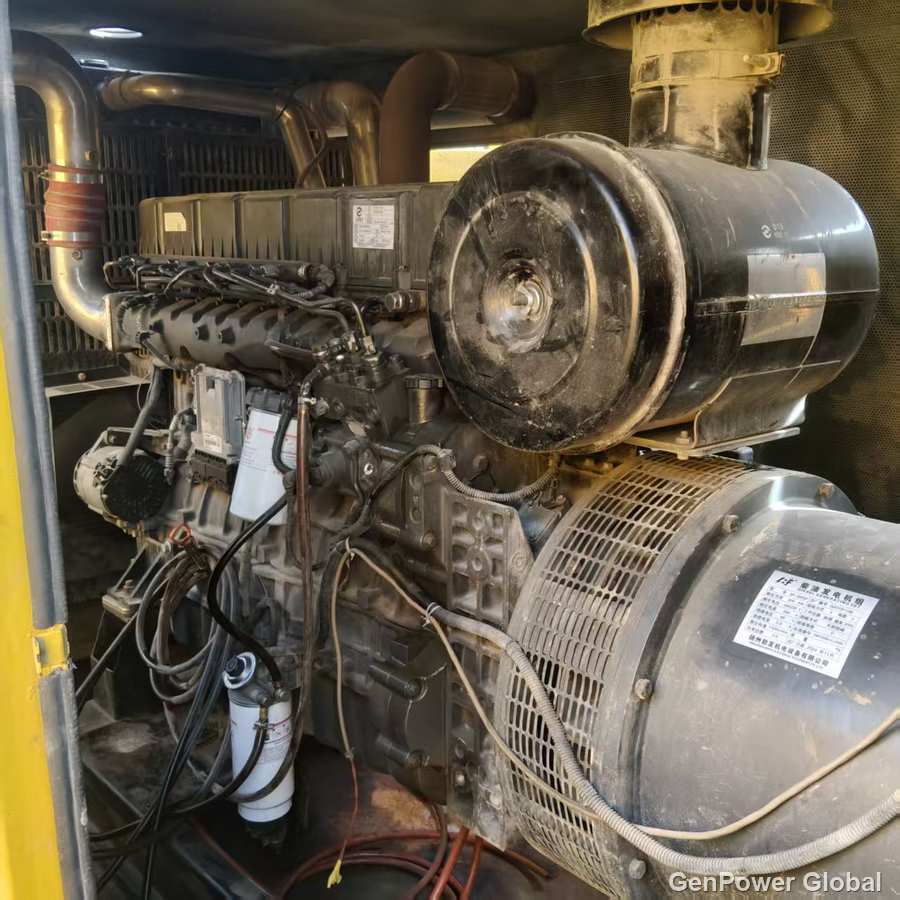
So learn the hierarchy. The engine makers that matter are Weichai, SDEC (Shanghai Diesel), Yuchai and Cummins’ Chinese joint-venture plants; these are volume manufacturers with their own dealer and parts networks. The assemblers — companies like Yangzhou Bofa, whose BF-300GF badge you can see in the photo above — buy engines and alternators on the market, design the canopy and the base frame, wire the control system and stamp the nameplate. Some assemblers are excellent, some are careless, and the canopy badge alone tells you very little. That is why the inspection section of this guide starts with the nameplate triangle: engine plate, alternator plate, genset plate, each read separately.
When we listed our two BF-300GF 300 kW sets — unit 3552G and unit 358G — we photographed all three plates precisely because the assembler’s name is the least important of them. What the plates establish is that a Weichai engine drives a brushless synchronous alternator, that the set is rated 300/300 kW at 400V and 50 Hz, and that it left the assembly plant in November 2024. Those facts, not the badge, are what you are buying.
2. Why the price gap against Cummins and CAT is so wide
In our FOB price breakdown we noted that a recognised engine family can sit roughly 20–40% above an unbranded set of the same kVA, and that number holds at the used market too. The gap has three honest sources and one dishonest one.
The first honest source is new-price arbitrage. A Chinese-brand set sells new for a fraction of a Western-branded equivalent, so the used price starts from a lower base. The second is resale value: a Cummins or CAT badge sells faster in Lagos and Mombasa second-hand markets, and dealers price that liquidity in. The third is perceived parts risk — buyers assume parts for a Weichai will be hard to find in Accra, which Section 5 shows is mostly no longer true.
The dishonest source is misrepresentation in both directions: Western-branded sets with dubious hour meters, and Chinese-brand sets marketed with inflated ratings. A “300 kW” set whose genset plate actually reads 250 kW prime is a different machine. Read plates, demand controller photos, and the gap becomes a genuine bargain instead of a lottery.
Supply matters too. China’s domestic rental fleets and industrial users retire sets on predictable cycles, and grid-extension programmes keep pushing whole regions off standalone diesel, which releases young, low-hour sets into the second-hand market at prices Western markets never see. At the same time the Chinese domestic resale market is deep enough that dishonest sellers cannot easily hide a bad reputation from the trade — dealers like us buy through the same channels our competitors do, and the trade knows which yards re-stamp plates. The result is that a patient buyer, working through a dealer who inspects in person, accesses machines at two or three years old that a Lagos or Nairobi buyer would otherwise never be offered.
3. What Chinese-brand sets cost FOB China in 2027
The table below is what we see quoted in the Chinese used market for mainstream-brand sets (Weichai, SDEC, Yuchai powered, credible assemblers), stated as 2026/2027 references and always subject to a live quote. Hours, canopy and documentation move each unit within — occasionally outside — these bands.
| Rating band | Typical year / hours band | Indicative FOB China (USD) |
|---|---|---|
| 50–100 kVA | 2018–2023, 1,000–6,000 hrs | 3,500–8,000 |
| 250–400 kVA | 2019–2025, 500–5,000 hrs | 8,000–15,000 |
| 500–700 kVA | 2016–2023, 1,000–8,000 hrs | 16,000–30,000 |
For comparison, our FOB breakdown put a used 100 kVA set at roughly 6,000–12,000 US dollars and a 500 kVA set at 22,000–45,000 FOB China across all brands — the Chinese-brand sets price in the lower half of those bands, and the recognised Western families in the upper half. A concrete anchor from our own stock: the BF-300GF sets mentioned above, nameplate November 2024 and around 3,000 hours, are listed at 11,200 US dollars FOB with the sound canopy (80,000 RMB; the open configuration runs 70,000 RMB), which lands in the middle of the 250–400 kVA band rather than at its floor — the nameplate date and the low hours are why.
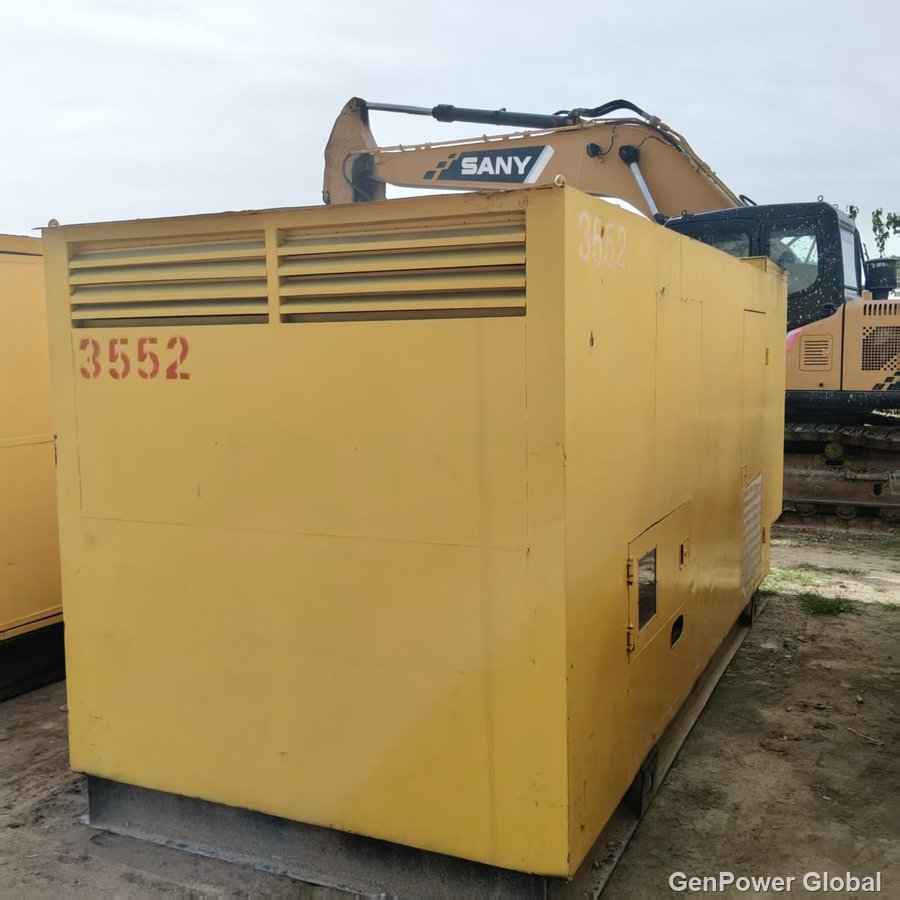
Two budgeting notes. First, canopy premium: a sound-attenuated build typically adds around 10–20% over open-skid, so decide before you compare quotes, not after. Second, if a seller quotes you a Chinese-brand set at half the band floor, the discount is the product — look for rewound alternators, re-stamped plates or hours that cannot be verified.
4. Reliability: what the nameplate and the hours really tell you
Hours outweigh calendar year on any used diesel, and Chinese-brand sets are no exception. The service life figure commonly quoted by rebuilders for Weichai and SDEC platforms of this class, with proper oil changes and cooling care, runs to around 15,000 hours before a major overhaul — a claim we repeat here as market lore rather than a promise we can contract on. A set showing 3,000 hours is therefore roughly a fifth into its working life, which is why the hours figure, verified, is worth more than the year on the plate.
Verification is where buyers get lazy. An hour meter can be replaced in ten minutes. What we do before listing any set, and what you should demand from anyone: a photo of the controller with the set running, a cross-check against service stickers and the general condition of the machine, and where possible a short load-test video. Oil analysis is cheap relative to the money at stake, and any seller who refuses a load test has told you everything you need to know.
Calendar year still matters in one specific way: emissions and build standard. A November 2024 nameplate like ours means current-production engine tooling and a control panel with modern protections. A 2012 build of the same rating is not automatically worse, but its wiring, hoses and mounts have ten more years of heat cycles in them, and your inspection should weight those items harder.
Learn to read the controller, because it is where the unit tells on itself. SmartGen and similar panels expose total hours, start count and fault history on their menu screens; a set claiming 500 hours with a start counter in the thousands has a story to tell. During a load test, watch three numbers rather than one: voltage and frequency stability as load steps up, water temperature under sustained load, and how quickly the set recovers when a step load is applied. A healthy pre-owned set settles back within a couple of seconds; one that dips and lingers is telling you about injector or turbo health long before the engine actually fails on site.
5. Parts and service in Africa
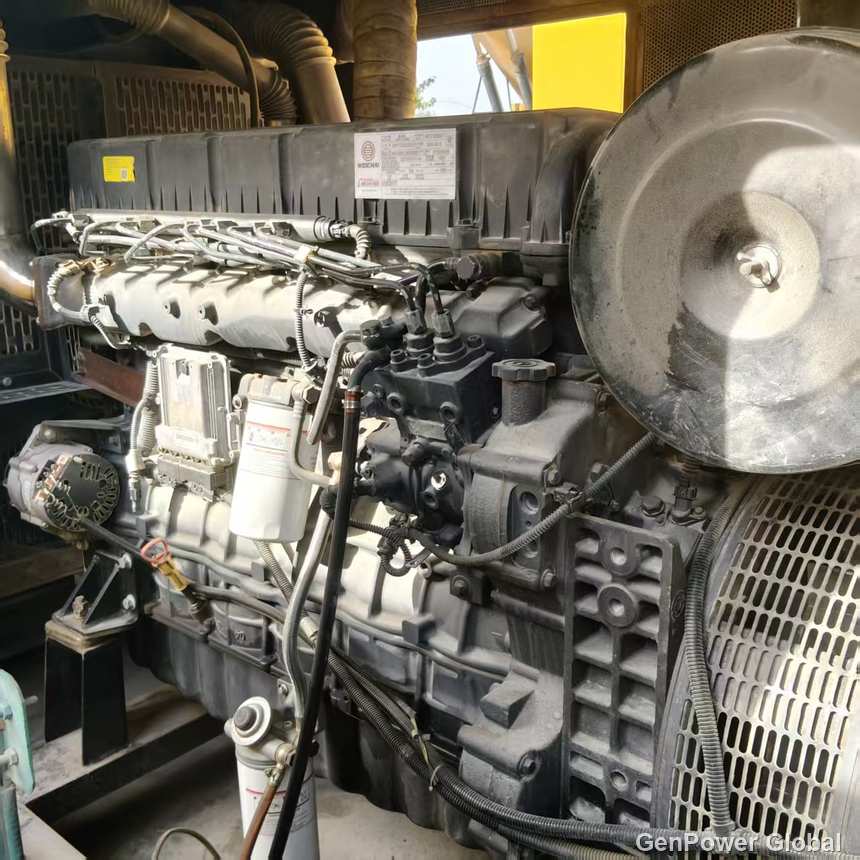
The parts argument against Chinese-brand sets is ten years out of date for the mainstream engine families. Weichai, SDEC and Yuchai engines share service items, filters and often complete blocks with the Chinese truck and construction fleets that already run across East and West Africa, so consumables move through the same parts markets in Lagos, Nairobi, Kano and Dar es Salaam at a fraction of dealer prices for imported engine families. Controller brands common on these sets (SmartGen and similar) are equally commoditised.
The honest residual risk sits with small assemblers: if the canopy badge belongs to a workshop that has since closed, nobody will support the wiring harness, the canopy hardware or the base tank — but the engine and alternator, the expensive parts, remain supported by their own makers. This is another reason the nameplate triangle matters more than the badge.
Our standing advice regardless of brand: ship a first-service kit with the set — oil filters, fuel filters, air filters, belts and two spare sets of consumables — and record the exact filter numbers before the container is sealed. A kit costs a few hundred dollars and buys you the first 500 hours without a parts hunt. For a fuller picture of how used equipment moves and pays for itself, our Africa importer’s guide covers the three machine families side by side.
One more commercial point: buy through someone who physically stands next to the machine. Marketplaces list photos; dealers who yard-inspect can tell you which door hinge was replaced, whether the fuel in the base tank is clean, and whether the controller matches the wiring diagram. The margin difference between a marketplace flipper and a stocking dealer is small relative to the cost of one wrong set: a genset that will not take load costs you the freight twice — once inbound and once back — before it has produced a single kWh.
6. A 7-point inspection checklist before you pay
Run every used Chinese-brand set — frankly, every used set of any badge — through these seven points. We run them before a unit gets a page on this site.
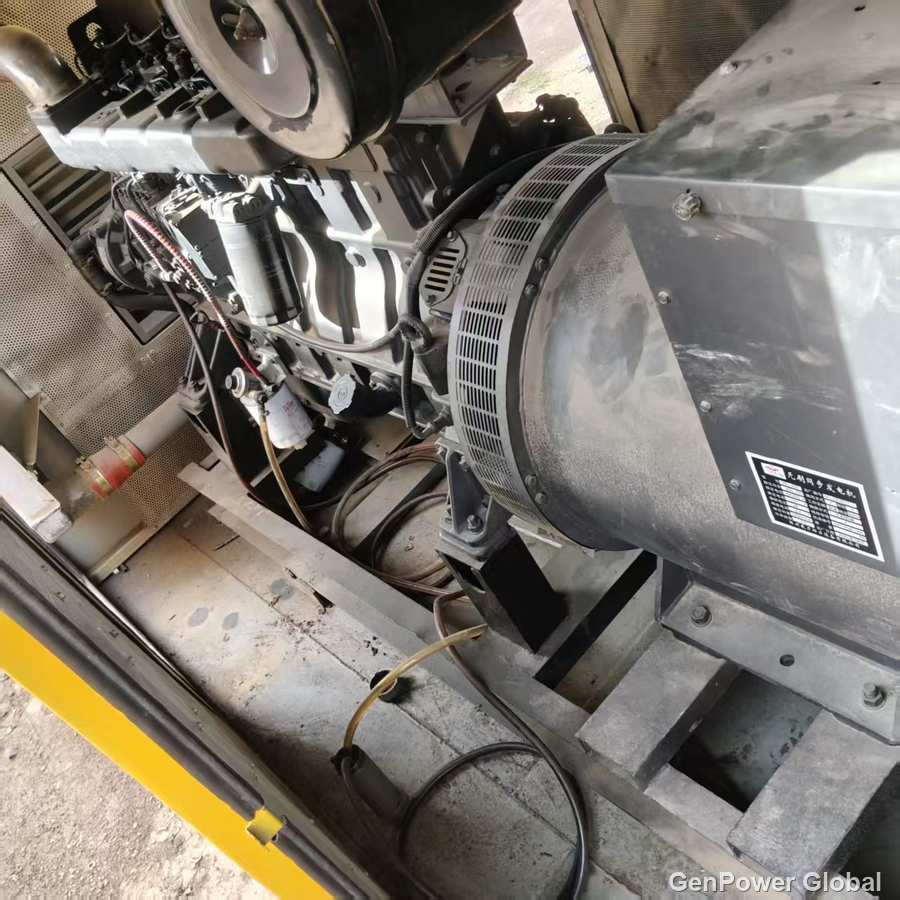
1. The nameplate triangle. Photograph and read the engine plate, the alternator plate and the genset plate separately. The ratings must agree: a 300 kW genset plate driven by an engine plate rated for less is a de-rated or re-badged unit. Our 358G detail page shows what a complete set of plate photos looks like.
2. Verified hours. Controller photo with the set running, cross-checked against service stickers and oil condition. Refusals end negotiations.
3. A real load test. The set should start, take load and hold frequency and voltage for 20–30 minutes. Ask for the video, not a screenshot.
4. Canopy and louvres. Sound sets live and die by their enclosures: check door hinges, louver fins, gasket condition and any crash repair on the frame. A bent canopy frame telegraphs a transport history the seller did not mention.
5. Alternator and terminal box. Open the terminal box: burnt smell, discoloured lugs or re-wound windings are disqualifying at any price. The alternator is the component most often ruined by overload and least often inspected.
6. Base frame and anti-vibration mounts. Cracked mounts and fretted base rails mean the set has been moved hard or run long out of balance. Cheap to fix, expensive to ignore.
7. Documentation. Manuals, wiring diagrams and whatever service history exists. On the export side, the serial numbers go on the invoice, and the plates we photograph become part of the buyer’s file.
Flipped around, the seven points become red flags: plates that disagree with each other, hours that cannot be demonstrated live, a seller who will not run the set, a canopy that looks straight but sits crooked on its base rail, a terminal box that smells burnt, mounts that have fretted their paint away, and a file with no manuals at all. Two or more of these on the same unit is not a discount opportunity; it is someone else’s problem wearing a price tag.
7. Compliance: the rules do not care about the badge
Nothing in Nigeria’s or Kenya’s import regime changes because the engine is Chinese. Generating sets are classified under HS 8502 and face the same duty structure, VAT and pre-shipment verification regardless of brand. In Nigeria, used generating sets generally sit outside the core SONCAP scope while clearing still runs through Form M and PAAR; Kenya’s PVoC programme normally requires a Certificate of Conformity before the set sails. Every one of these statements moves with policy — treat them as orientation only and confirm with SON and KEBS, subject to the latest official notice. Our Kenya & Tanzania import-rules guide walks the process in detail.
Budget the sea leg realistically too: a 40-foot container from China has recently run around 3,150–3,650 US dollars to either Mombasa or Lagos before surcharges, and a 300 kW silent set fits that box with room for the service kit. All freight figures are 2026/2027 references, subject to a live quote and the latest official notice on surcharges and routing.
8. FAQ
Are Chinese-brand diesel generators reliable enough for Africa?
A well-maintained Chinese-brand set from a major engine maker such as Weichai, SDEC or Yuchai is a workhorse, not a gamble. The risk sits in the small assemblers and in dishonest hour meters, not in the engine platforms themselves. Inspect the nameplates, demand a load test, and judge the unit, not the badge.
Weichai or Cummins: which engine should a used 300 kW set have?
A Cummins-powered set holds resale value better and has the deeper dealer network, and it will usually cost 20 to 40 percent more than the same rating on a Chinese engine family. A Weichai-powered set costs less to buy and its filters and consumables are inexpensive and widely stocked. If your budget is tight and you can verify hours, the Weichai set is the better value; if resale in three years matters more, lean Cummins.
How much does a used Chinese-brand 300 kW generator cost FOB China?
In the Chinese used market through 2026, a silent 250 to 400 kW Chinese-brand set typically quotes between 8,000 and 15,000 US dollars FOB, subject to a live quote. As a concrete anchor, our two Bofa BF-300GF 300 kW silent sets, nameplate dated November 2024 and showing roughly 3,000 hours, are listed at 11,200 US dollars FOB with canopy.
Can I get spare parts for Weichai and Chinese-brand sets in Nigeria or Kenya?
Yes for the mainstream engine families. Weichai, SDEC and Yuchai engines share many service items with Chinese truck and construction engines, so filters, belts and injectors move through the same parts markets in Lagos, Nairobi and Kano. Ship a first-service kit with the set anyway, and confirm the exact filter numbers before loading.
Do import rules in Nigeria and Kenya treat Chinese-brand generators differently?
No. Rules follow the product category and its HS code, not the brand on the canopy. Generating sets under HS 8502 face the same duty structure, VAT and pre-shipment verification whether the engine is Chinese, American or British. Confirm the current requirements with SON in Nigeria and KEBS in Kenya, subject to the latest official notice.
How do I verify the running hours on a used Chinese genset?
Ask for a photo of the controller with the set running, cross-check the hour reading against service stickers and oil condition, and be suspicious of a set that claims very low hours with heavy wear on the pedals, louver hinges and canopy paint. Our own rule: if the seller will not run the set on video, do not buy the set.
The short version
Chinese-brand used generators are not a compromise category any more; they are a price-performance category, and the buyers who treat them that way — reading plates instead of badges, verifying hours instead of trusting them, and pricing the parts kit before the freight — are the ones who get the genuine bargain the gap promises — Western-grade ratings at Chinese-brand prices, on machines whose expensive components were never the cheap part. Start with the two BF-300GF sets we just listed, unit 3552G and unit 358G, compare them against the rest of the generator stock, and if you want the plates, the controller photo and the load-test video for either unit, send us your port and we will put the file together. General questions are answered on our FAQ page.
Prices, hours and nameplate details in this guide are 2026/2027 references checked against the units in our yard; every figure is subject to a live quote and the latest official notice of the relevant authorities.